
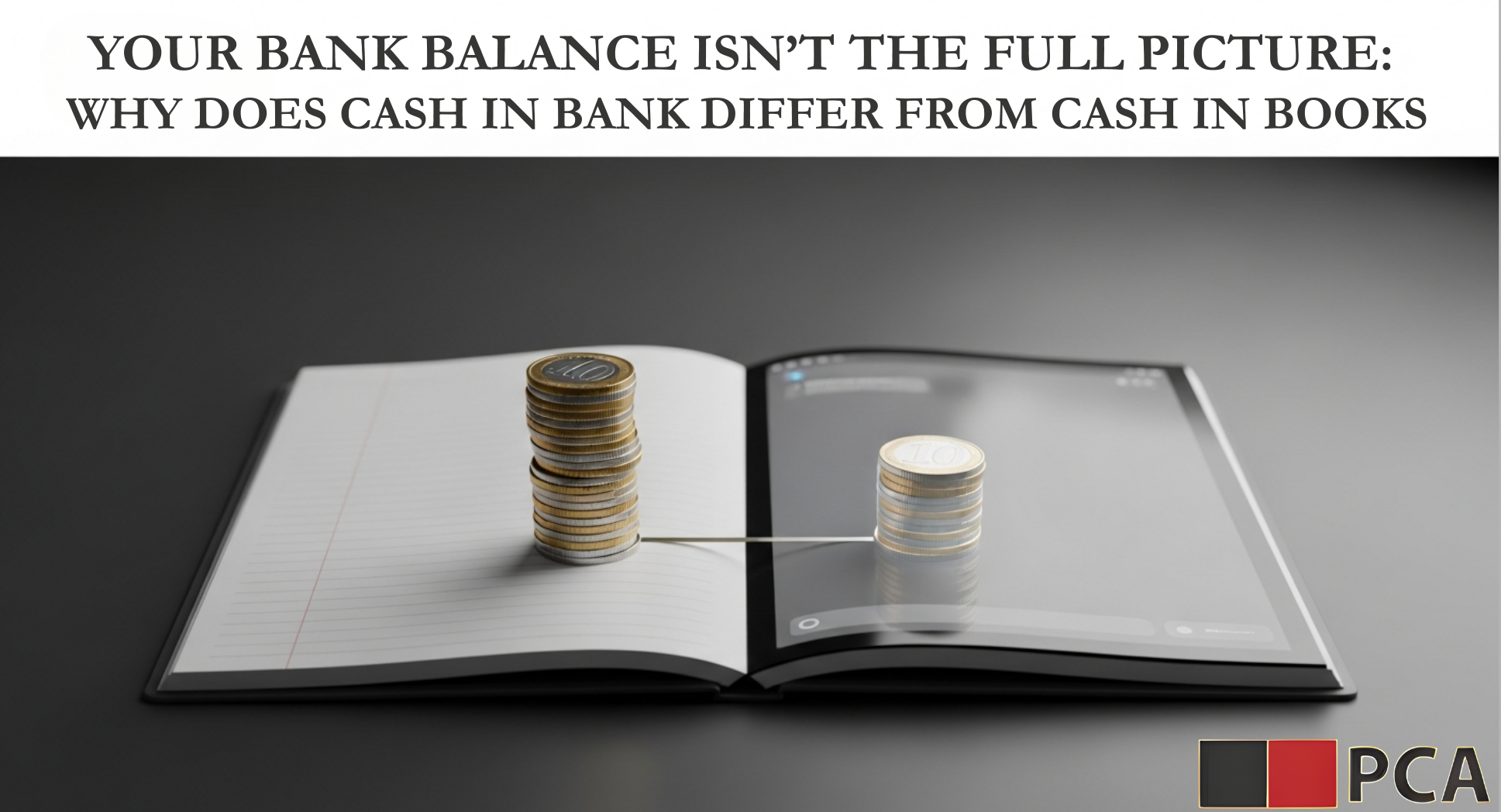
Your Bank Balance Isn’t the Full Picture: Why Cash in Bank Differs from Cash in Books
Why Cash in the Bank Differs from Accounting Profit — and Why Businesses Still Need an Accountant
Many business owners review their bank account and assume they understand the financial position of the company.
Cash has been received.
Most of it has already been spent.
Yet the accounting reports still show taxable profit.
This situation often creates confusion — even frustration. If there is little cash left, how can the company still be profitable?
The explanation lies not in accounting error, but in a fundamental distinction: cash flow and profit are not the same concept. They are measured differently and serve different purposes.
Article Outline
- I. Cash Flow and Profit Measure Different Things
- II. When Cash Decreases but Profit Does Not
- III. Why Taxable Profit May Be Higher Than Expected
- IV. Where Does the Profit Exist If Not in Cash?
- V. Why Businesses Still Need an Accountant
- VI. Conclusion
- PCA Note
I. Cash Flow and Profit Measure Different Things
A bank account reflects cash movements. It shows how much money has entered and left the account, and how much remains at a specific point in time.
Accounting records, however, are designed to measure economic value. They reflect revenue earned, expenses recognized, assets accumulated, and tax liabilities incurred in accordance with accounting and tax regulations.
Because these two systems operate under different principles, their figures will not always match – and they are not meant to.
Cash flow focuses on liquidity. Accounting profit focuses on performance and value creation.
Key Takeaway: Cash flow shows how money moves. Profit shows how value is created. They answer different financial questions.
II. When Cash Decreases but Profit Does Not
There are many common situations where cash leaves the bank account but accounting profit remains unchanged.
Input VAT is generally creditable or refundable, so it is not treated as an expense.
Purchases of fixed assets are capitalized and allocated over time through depreciation.
Security deposits are recorded as assets because they are refundable.
Prepaid expenses are recognized only when the related service is consumed.
Corporate Income Tax represents a settlement of tax liability, not a cost that generates revenue.
In each of these cases, cash decreases — but profit does not necessarily change at the same time.
Key Takeaway: Not every cash payment is an expense. The timing and nature of a transaction determine its impact on profit.
III. Why Taxable Profit May Be Higher Than Expected
Another source of misunderstanding comes from non-deductible expenses.
A business may incur actual costs, but if those expenses lack valid VAT invoices, sufficient documentation, or fail to meet tax deductibility requirements, they will not be accepted as deductible expenses for Corporate Income Tax purposes.
Economically, money has been spent. From a tax perspective, the expense is disallowed.
As a result, taxable profit increases.
Key Takeaway: An expense only reduces taxable profit if it meets regulatory requirements. Documentation and compliance directly affect tax outcomes.
IV. Where Does the Profit Exist If Not in Cash?
Profit does not always exist in the form of available cash. It may be reflected in accumulated assets such as recoverable VAT, fixed assets, inventory, deposits, or other recorded values.
Profit represents the net economic gain generated during a period. It is an increase in business value, not merely an increase in bank balance.
Key Takeaway: Profit is reflected in assets and accumulated value — not just in cash sitting in the bank.
V. Why Businesses Still Need an Accountant
If bank balances do not represent profit, and profit does not represent immediately spendable cash, financial management cannot rely solely on reviewing online banking statements.
Accounting ensures proper classification of transactions, accurate timing of revenue and expense recognition, correct calculation of taxable income, and compliance with regulations.
It protects deductible expenses, explains differences between operational cash flow and reported profit, and reduces long-term financial and tax risks.
Key Takeaway: Accounting provides structure, compliance, and clarity — turning raw cash movements into meaningful financial information.
VI. Conclusion
Differences between bank balances and accounting profit are not signs of error. They arise because each system measures different aspects of business activity.
The bank reflects liquidity at a given moment. Accounting reflects economic performance and accumulated value over time.
Understanding this distinction enables businesses to interpret financial results correctly, manage tax obligations properly, and make informed decisions based on reliable data.
PCA Note
Financial figures only become meaningful when they are properly interpreted within the right accounting and regulatory context. A bank balance alone does not provide a complete financial picture – structured records and compliant reporting do.
PCA supports businesses in maintaining accurate accounting systems, reconciling bank and book balances properly, and ensuring compliance with Vietnamese regulatory requirements. With clear financial data and structured advisory support, companies are better positioned to make informed decisions based on substance rather than surface numbers.
A timely consultation with PCA provides structured financial support, supporting you to focus on starting, growing, and leading your business with confidence.
Email: info@pca-cs.com
Hotline: +84 (0) 90909 0415 | +84 (0) 909091141
Author: PCA Teams