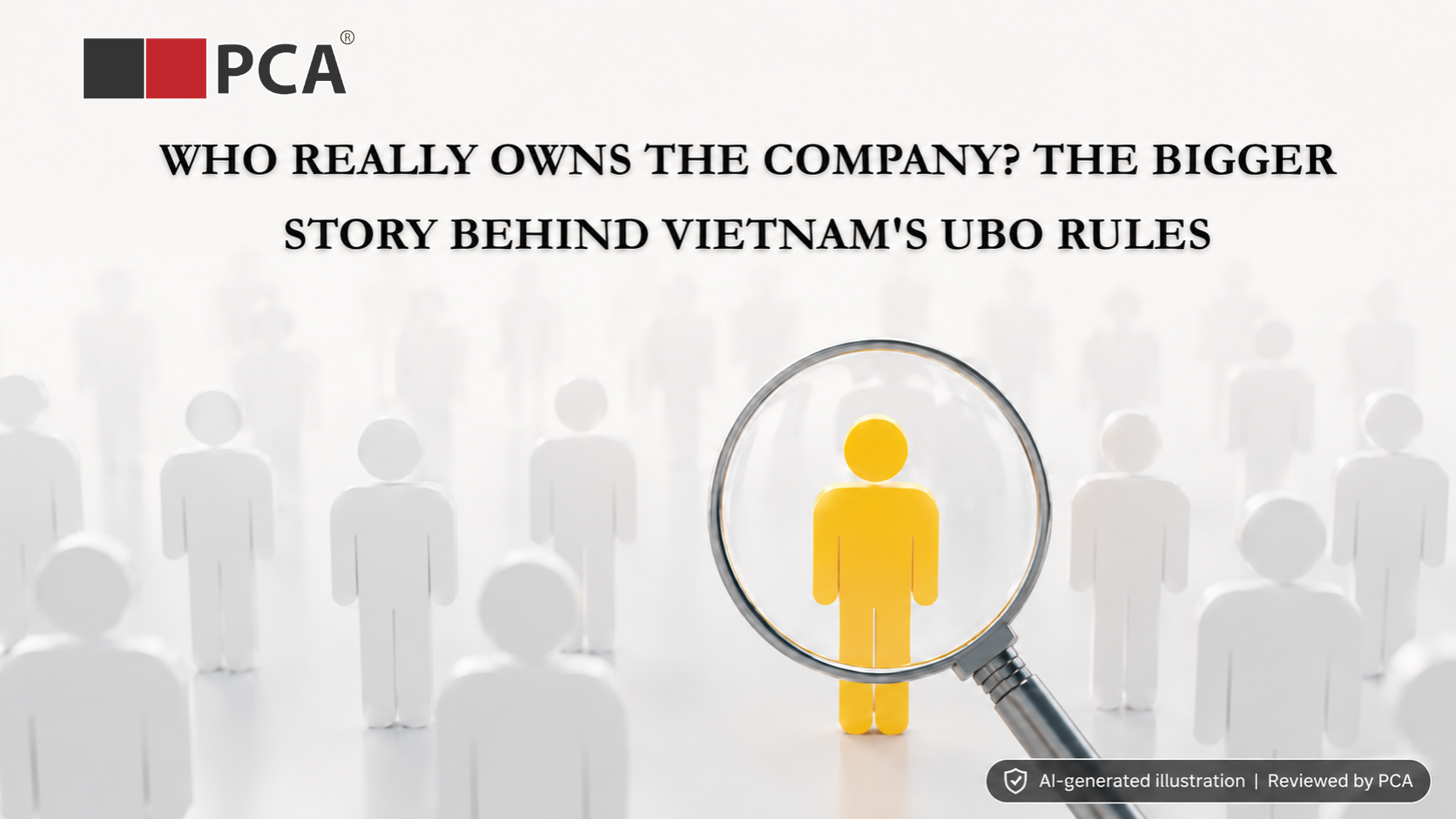
Who Really Owns the Company? The Bigger Story Behind Vietnam's UBO Rules
Introduction
In our previous article, we discussed what businesses are required to disclose under Vietnam’s Ultimate Beneficial Owner (UBO) framework.
This time, we explore the bigger question behind those requirements: Why is identifying the real controlling person becoming increasingly important?
At first glance, the answer may seem straightforward. Most people would assume that the shareholder listed on company records is also the person who owns and controls the business.
In practice, however, ownership, control, funding, and economic benefit do not always sit with the same individual. Under Vietnam’s amended Law on Enterprises and Decree 168/2025/NĐ-CP, beneficial ownership disclosure is increasingly intended to provide greater transparency regarding the individuals who ultimately own, control, or benefit from a business.
Understanding this distinction helps explain the broader purpose behind Vietnam’s evolving UBO framework.
Article Outline
- I. When Ownership and Control Are Not the Same Thing
- II. Nominee Structures: Not Unique to Vietnam
- III. Why Authorities Increasingly Want to Understand the Real Controller
- IV. What Businesses Should Understand Moving Forward
- PCA Note
I. When Ownership and Control Are Not the Same Thing
One of the most important concepts behind UBO is that legal ownership and actual control are not always the same thing.Corporate records typically identify shareholders, directors, and legal representatives. However, these records do not always reveal who ultimately influences decisions, controls resources, or benefits economically from the business.
Consider the following situation:
-
One individual appears as the shareholder on official records.
-
Another person provides the investment capital.
-
A third person makes the strategic decisions.
Which of them truly controls the business?
Increasingly, this is the question UBO frameworks seek to answer.
A company’s shareholder register may identify one person. The individual approving major commercial decisions may be another. The person ultimately receiving the economic benefits may be someone else entirely.
Looking through this lens, UBO is not simply about identifying names. It is about understanding where control, influence, and economic benefit ultimately reside.
For this reason, authorities are increasingly interested not only in ownership structures, but also in understanding how ownership, funding, and decision-making interact in practice.
Key Takeaway: The shareholder register does not always tell the full story. UBO frameworks seek to understand who ultimately exercises influence, controls outcomes, and benefits from the business, regardless of whose name appears on paper.
II. Nominee Structures: Not Unique to Vietnam
One of the clearest examples of the separation between ownership and control is the nominee arrangement.
In simple terms, a nominee arrangement exists when one person appears in official company records on behalf of another person who remains behind the structure. The nominee may legally hold shares or occupy a formal role. However, another individual may provide the funding, receive the economic benefits, or exercise practical control over the business.
From a PCA’s perspective, the existence of nominee arrangements is unlikely to surprise Vietnamese regulators. Similar structures have existed globally for decades and remain common in many cross-border investment and holding environments. The more important question is not whether these arrangements exist, but whether businesses can clearly explain who ultimately stands behind them when clarification is required.

Hong Kong: Recognised, but strictly transparent
In Hong Kong, nominee arrangements have long been part of the corporate landscape, particularly in international investment and holding structures. Rather than prohibiting these arrangements, the regulatory focus is on ensuring that individuals exercising significant control can be identified when necessary.
To support this objective, Hong Kong requires:
-
a Significant Controllers Register (SCR), which records individuals or entities exercising significant control over the company; and
-
compliance with AML and KYC obligations by Trust or Company Service Providers (TCSPs) involved in company administration and corporate structuring.
In practice, the existence of a nominee is not usually the primary concern. The more important issue is whether the company can demonstrate who ultimately stands behind the structure.
Singapore: Similar objective, structured disclosure
Like Hong Kong, Singapore recognises that legal ownership and practical control do not always overlap. Its regulatory framework therefore focuses on ensuring that the individuals ultimately controlling or benefiting from a company can still be identified when necessary.
To support this objective, Singapore requires companies to maintain:
-
a Register of Registrable Controllers (RORC), which records individuals or entities with significant ownership or control;
-
a Register of Nominee Directors, identifying directors acting on behalf of another person; and
-
a Register of Nominee Shareholders, recording nominee shareholding arrangements and the individuals behind them.
The practical message is straightforward: Nominee arrangements may exist for legitimate commercial reasons, but regulators still expect sufficient visibility over who ultimately controls or benefits from the structure.
Vietnam: Different framework, similar direction
Vietnam does not currently apply the same nominee-specific registers as Hong Kong or Singapore. However, recent UBO regulations reflect a similar direction.
The focus is increasingly on:
-
ownership transparency;
-
visibility of control structures;
-
identification of the ultimate beneficial owner; and
-
understanding who ultimately stands behind a business.
Rather than focusing only on individuals named in corporate records, the framework seeks greater visibility into the people and arrangements behind a company’s ownership and control structure.
A company may involve holding entities, investment vehicles, family arrangements, or nominee relationships that make the link between legal ownership and practical control less obvious.
The key issue is not whether such structures exist. The real question is whether the business can clearly explain who ultimately controls the structure, who benefits from it, and who should be regarded as the final controlling person when clarification is required.
Key Takeaway: The issue is not whether nominee arrangements exist. The issue is whether the ultimate controlling party can be clearly identified and explained when required.
III. Why Vietnamese Authorities Increasingly Care About the Real Controller
Viewed from this perspective, UBO is about far more than maintaining ownership records. It is fundamentally about visibility, accountability, and transparency.
1. Anti-Money Laundering and Financial Transparency
One of the most widely recognised objectives behind beneficial ownership frameworks is anti-money laundering.
Without knowing who ultimately controls a business, it becomes significantly more difficult to understand:
- where funds originate;
- who benefits from transactions;
- who controls financial decisions; and
- who should ultimately be accountable.
UBO disclosure helps authorities better understand the relationship between ownership structures and financial activity.
2. Understanding Accountability Behind Business Decisions
Viewed another way, UBO is not only about understanding who owns a business. It is also about understanding who is ultimately accountable for the decisions made within it.
When questions arise regarding the origin of funds, related-party transactions, ownership arrangements, or significant commercial decisions, authorities increasingly seek to identify the individuals who were genuinely in a position to influence those outcomes.
In some situations, the person exercising that influence may not be immediately visible from the shareholder register alone.
Understanding where decision-making authority actually sits can therefore be just as important as understanding who formally owns the shares.
3. Transfer Pricing and Management Control
UBO information is also increasingly relevant in transfer pricing analysis.
In cross-border structures, tax authorities often look beyond formal ownership to understand where real management and control are located.
Key questions may include:
-
Who approves major transactions?
-
Who sets strategic direction?
-
Who controls budgets and investment decisions?
-
Where is effective management actually exercised?
This is particularly relevant under Vietnam’s transfer pricing framework, where authorities apply a substance-over-form approach when assessing related-party relationships.
As a result, businesses that appear unrelated on paper may still attract attention if the same individual ultimately directs or controls their activities.
From this perspective, beneficial ownership information can provide a clearer understanding of management substance, control relationships, and potential related-party risks.
IV. What Businesses Should Understand Moving Forward
For businesses, one important takeaway is that UBO disclosure should not be viewed as a standalone filing exercise.
Information provided today may later become relevant in various contexts, including:
- banking due diligence;
- investment transactions;
- tax reviews;
- transfer pricing assessments;
- regulatory inspections; or
- ownership clarification requests.
This does not necessarily imply increased enforcement activity. Rather, it reflects a broader movement toward greater transparency regarding who ultimately stands behind a business.
For companies operating through layered ownership structures, foreign holding entities, family arrangements, or nominee relationships, the key issue is often not the structure itself. The key issue is whether the structure can be clearly understood, consistently documented, and credibly explained when questions arise.
Key Takeaway: UBO disclosure forms part of a broader transparency framework. Information collected today may become relevant in future regulatory, financial, or transactional reviews.
PCA Note
In PCA’s experience, many businesses do not intentionally create opaque ownership structures. More often, ownership, funding, decision-making authority, and economic benefit have simply evolved over time through practical business arrangements, investment relationships, or historical corporate structuring decisions.
As transparency expectations continue to evolve, the challenge is increasingly not whether a structure is complex, but whether the business can clearly explain how it works.
When ownership, control, and economic benefit no longer sit with the same individual, being able to articulate those relationships may become just as important as maintaining the structure itself.
For further guidance on ownership mapping, beneficial ownership analysis, corporate structuring, and UBO-related disclosure considerations, the PCA teams can assist businesses in understanding their structures and assessing potential compliance implications.
Email: info@pca-cs.com
Hotline: +84 (0) 90909 0415 | +84 (0) 909091141
Author: Chief Legal Officer – Attorney-at-law, Ms. Trương. M. Đ. Thư
Tags: #UBOVietnam, #UltimateBeneficialOwner, #VietnamCompliance, #CorporateTransparency, #AMLComplianceVietnam, #ForeignInvestmentVietnam, #TransferPricingRisk, #TaxComplianceVietnam, #KYCVietnam
References