
Vietnam’s Tax ID Clean-Up Campaign: Is Your Inactive Company Really Closed?
Introduction
Closing the office does not close the company.
A business may have stopped trading, vacated its registered address or remained inactive for years. However, until its tax status has been properly resolved, it may not be fully closed for tax purposes.
An unresolved status can delay dissolution, hinder or delay the restoration of business operations, and complicate subsequent corporate or investment procedures.
This issue is the focus of Vietnam’s 2026 “Tax ID Clean-Up – Removing Bottlenecks in Business” campaign, introduced under Decision No. 595/QĐ-CT dated 8 May 2026.
The campaign focuses principally on taxpayers recorded as:
- Status 03: operations ceased but the procedure to terminate the validity of the tax identification number has not been completed; or
- Status 06: not operating at the registered address.
It also addresses cases where stolen or falsified personal information has been used to establish enterprises or business households that do not reflect genuine business activity.
For foreign-invested businesses, resolving the tax status may require coordination with enterprise registration, investment licensing, employment, social insurance, customs, banking and the repatriation of remaining funds.
The practical question is whether the company intends to Exit, Return or Verify.
Article Outline
- I. Why the Tax ID Clean-Up Campaign Matters
- II. Three Business Situations: Exit, Return or Verify
- III. How an Unresolved Tax Status Can Affect Your Business
- PCA Note
I. Why the Tax ID Clean-Up Campaign Matters
A tax identification number is not merely a reference number on a tax return. It connects the company, its legal representative, registered address, filing history, invoices, tax liabilities and operating status across Vietnam’s administrative systems.
A company’s tax records reflect its registered status, legal representative, address, filing history, invoices, and outstanding tax obligations.
Problems arise when those records no longer correspond to the company’s actual circumstances.
A foreign-invested company may have:
- Stopped operating without completing its closure procedures;
- Moved away from its registered address;
- Failed to submit required tax declarations;
- Left invoices or tax liabilities unresolved;
- Suspended operations without completing the required notifications; or
- Inconsistent tax, enterprise or investment records.
The campaign is intended to bring taxpayer data into line with business reality, assist eligible taxpayers in completing termination or restoration procedures, and identify cases requiring further examination.
The campaign does not create new tax obligations; it focuses on resolving existing obligations and correcting taxpayer records.
The applicable framework includes the Law on Tax Administration No. 108/2025/QH15, Decree No. 252/2026/NĐ-CP and Circular No. 90/2026/TT-BTC. Circular No. 90/2026/TT-BTC has been applied since 1 July 2026.
Key Takeaway: Stopping commercial activity does not end the company’s tax and legal obligations. Its recorded status must also be resolved.
II. Three Business Situations: Exit, Return or Verify
These are practical directions rather than statutory classifications. The appropriate route depends on the company’s recorded status, actual activities and future intentions.
1. Exit: The Business Has Ceased Operations
For foreign-invested companies, tax termination, enterprise dissolution and investment-project termination are connected but separate procedures. The appropriate sequence depends on the company’s status, registration structure and outstanding obligations.
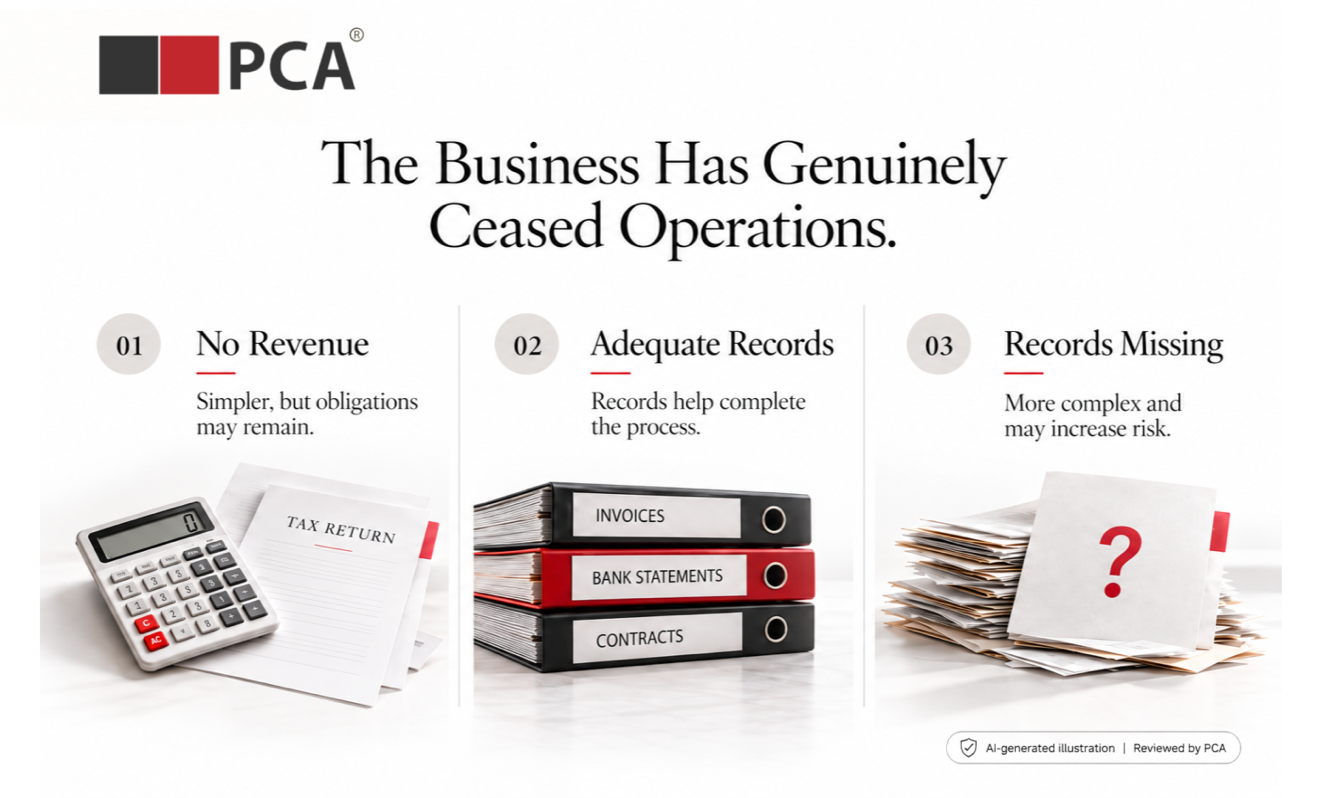
|No Revenue
A company with no revenue and no invoice activity may have a less complex tax position. However, “no revenue” does not automatically mean “no obligations.”
Missing declarations, outstanding business licence fee liabilities for 2025 or earlier, administrative penalties or other applicable requirements may still need to be addressed before the tax identification number can be terminated.
The business licence fee is no longer payable or declarable for 2026 and subsequent years. Liabilities arising for 2025 or earlier may nevertheless remain outstanding.
|Revenue with Adequate Records
Where the company has maintained accounting books, invoices, contracts, bank statements and supporting documents, those records can be used to establish its actual tax position and complete the required filings.
Adequate records do not remove tax exposure, but they enable the company to explain its transactions and support its declared tax treatment.
|Revenue with Missing Records
Where the company generated revenue but cannot provide reliable accounting books or supporting documents, resolving its position becomes more difficult.
Where the company cannot accurately declare or substantiate its tax position, the tax authority may apply tax-assessment measures in accordance with applicable tax-administration rules, using the information and evidence legally available to it.
The company may also be unable to support deductible expenses, input VAT or the nature of particular transactions.
Reconstructing the accounting records may therefore be necessary. This work must rely on existing and recoverable evidence. It cannot create documents, transactions or deductions that did not exist.
2. Return: The Business Intends to Resume Operations
Where the relevant registration has not been revoked and the tax identification number has not yet been terminated, a company recorded as not operating at its registered address may, subject to the applicable requirements, apply to restore the validity of its tax identification number.
Restoration is not automatic. The tax authority may review the company’s address, legal status, outstanding obligations and the circumstances leading to Status 06.
The company should also review whether its legal representative, registered address, Enterprise Registration Certificate, Investment Registration Certificate and licensed activities remain appropriate for its intended operations.
3. Verify: The Recorded Status Requires Clarification
Some businesses must first establish why their information has been placed under review.
This may occur where:
- The company continues operating but its address could not be verified;
- Tax notices were sent to outdated contact details;
- The legal representative or investor information has changed;
- Tax, enterprise and investment records are inconsistent;
- The company cannot identify its outstanding declarations; or
- A branch, representative office or business location remains unresolved.
Status 09 means that the taxpayer is awaiting verification of its operation at the registered address. A company in this position should clarify the underlying issue rather than assume that it has already been classified as having ceased operations.
Key Takeaway: The business must first identify whether it needs to close, resume operations or correct its recorded information.
III. How an Unresolved Tax Status Can Affect Your Business
An unresolved tax identification number may delay or complicate:
- Company dissolution or investment-project termination;
- Restoration of business operations;
- Changes to the registered address or legal representative;
- Amendments to enterprise or investment registrations;
- Registration and use of electronic invoices; and
- Tax-clearance and compliance procedures.
For foreign-invested businesses, a complete exit may also involve employees, social insurance, customs, contracts, bank accounts, remaining assets and the lawful repatriation of funds.
Similarly, restoring the tax identification number does not automatically resolve separate investment, labour, banking or sector-specific requirements.
Delay can also make it harder to recover accounting records, invoices, bank documents and information from former employees or service providers.
PCA Note
Resolving an inactive or inconsistent tax status begins with two questions: what the company intends to do next, and what reliable evidence remains available.
PCA supports foreign-invested businesses in establishing their actual tax position, identifying unresolved obligations and, where appropriate, reconstructing accounting records from recoverable evidence. This work may also include preparing the relevant filings and explanations, supporting communications with the competent authorities, and coordinating the tax process with the necessary enterprise and investment procedures.
For further advice on resolving an inactive, suspended or inconsistent tax status in Vietnam, clients may contact the PCA Team for a tailored assessment. Clients may also request PCA’s practical recommendations on this topic.
Legal Basis
Law No. 108/2025/QH15 on Tax Administration, particularly Article 24(2)(b), (c) and (d).
Ministry of Finance explanation of the Campaign’s scope, objectives and relevant taxpayer statuses.
Contact us now!
Email: info@pca-cs.com
Hotline: +84 (0) 909 090 415 | +84 (0) 909 091 141
Author: Mr. Nguyễn Quốc Tứ, Chief Financial Officer
Tags: #VietnamTax #TaxIDCleanUpCampaign #ForeignInvestedBusiness #FDIVietnam #VietnamTaxCompliance #TaxTermination #TaxRestoration #AccountingReconstruction #BusinessContinuity #DoingBusinessInVietnam