
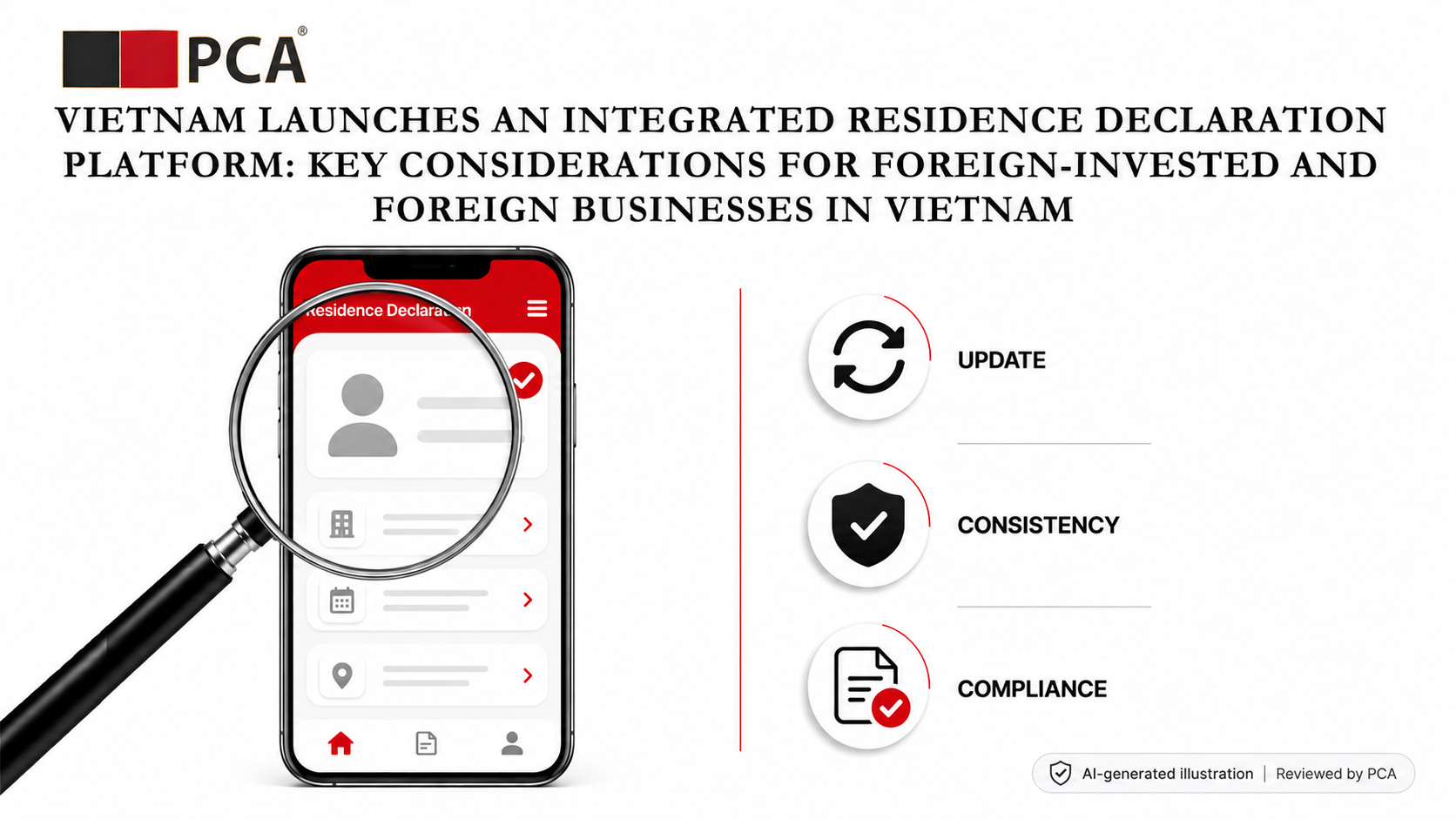
Vietnam’s Integrated Temporary Residence Platform: Emerging Compliance Risks for Foreign-Invested Enterprises
Introduction
Effective from 24 July 2026, Vietnam has introduced a unified electronic framework for temporary-residence declarations for foreign nationals.
For businesses, the key point is not the portal itself. It is that residence information is becoming more structured, visible and easier to compare with other immigration and administrative records.
FIEs should therefore treat temporary-residence information as part of their wider foreign-employee compliance record—not as a standalone filing task.
Article Outline
- I. Introduction to the New Digital Residence Platform
- II. Existing Residence Obligations Remain in Place
- III. Why This Matters for FIEs
- PCA Note
I. Introduction to the New Digital Residence Platform
Vietnam has been steadily digitizing public administration in recent years. The new platform is another step toward creating a more connected and efficient government system.
Since May 2026, temporary residence declaration for foreign nationals and residence notification for Vietnamese citizens have been handled through a single online portal: https://tbltkbtt.bocongan.gov.vn/
Key Platform Features
To simplify daily administration, the platform includes several practical functions, such as:
- online account registration;
- management of multiple properties under one account;
- sub-accounts for employees;
- automatic scanning of passport and identity information; and
- online access to previous residence records.
Who Must File the Declaration?
The responsibility to submit the declaration rests with the person directly managing or operating the accommodation. This may include:
- A hotel, serviced apartment, guesthouse or homestay;
- An individual landlord;
- An employer that provides accommodation to a foreign employee; or
- Another accommodation provider where the foreign national stays overnight.
A foreign national cannot submit the temporary-residence declaration independently. Their responsibility is to provide the accommodation provider with a valid passport or travel document and the relevant residence information so that the provider can complete the filing.
For hotels, the declaration system must be connected online to transmit foreign guests’ temporary-residence information. Other accommodation providers may use the electronic system or submit directly to the competent local police authority, as applicable.
II. Existing Residence Obligations Remain in Place
The platform changes the reporting method, not the underlying obligation.
- Reporting Deadlines
Accommodation providers must submit the declaration:
- within 12 hours after arrival in centrally-governed and major cities (such as Hanoi, Ho Chi Minh City, Da Nang, Hai Phong, and Can Tho); or
- within 24 hours in remote, mountainous, or island areas.
A new declaration is also required whenever a foreign national:
- changes residential address;
- temporarily stays at another location; or
- receives a new passport.
- Required Documents
Foreign nationals should provide:
- a valid passport (or another international travel document); and
- proof of lawful stay in Vietnam, such as:
- a visa;
- a Temporary Residence Card (TRC); or
- a visa exemption document.
Where the declaration is submitted directly to the local ward police, Form NA17 (Temporary Residence Declaration Form) must also be completed.
Key Takeaway: The platform changes how residence information is reported, but not the obligation to report. More importantly, it reflects Vietnam’s continuing move toward a more integrated digital administration system.
III. Why This Matters for FIEs
A declaration may be filed by a landlord or accommodation provider, but the information often affects the company’s wider foreign-employee compliance file.

Problems usually arise when information is updated in one place but not another. For example:
- A foreign employee moves to a new apartment, but HR is not informed or the residence declaration is delayed;
- A new passport is issued, but the accommodation provider continues using the previous passport details;
- The residential address in HR, immigration and payroll records does not match; or
- No one is clearly assigned to coordinate with the landlord or accommodation provider.
These inconsistencies may become visible when the company prepares a work-permit or TRC application, responds to an immigration request or reviews its foreign-employee documentation.
PCA Note
Over the years, PCA has observed that compliance issues involving foreign employees rarely arise from a single missing document. More often, they result from information that has gradually become inconsistent across different records maintained by various parties.
As Vietnam continues to advance digital administration and data integration, businesses may benefit from periodically reviewing residence and immigration information as part of their broader compliance management process, rather than only when a renewal or government procedure becomes necessary.
For organizations seeking further clarification on temporary residence declaration requirements or foreign employee compliance in Vietnam, the PCA Team remains available to discuss your specific circumstances.
Email: info@pca-cs.com
Hotline: +84 (0) 90909 0415 | +84 (0) 909091141
Author: The PCA Immigration Team
Tags: #VietnamTemporaryResidenceDeclaration, #ForeignEmployeeComplianceVietnam, #ImmigrationComplianceVietnam, #ForeignInvestedEnterprise, #DigitalAdministrationVietnam, #VietnamResidenceManagement, #TRCVietnam