
Vietnam VAT Return Changes 2026: Avoiding Future Compliance Risks Through Proper Accounting Management
Introduction
Starting 1 July 2026, businesses filing VAT returns in Vietnam will be required to apply the updated Form No. 01/GTGT under Circular No. 89/2026/TT-BTC.
While the regulation introduces welcomed flexibility into the tax filing process, its true strategic impact lies in how input VAT adjustments are identified, evaluated, and reported by accounting teams.
Under the updated framework, certain eligible prior-period adjustments can be recorded directly in the current VAT return through Items [37] and [38], eliminating the need for an amended return for the original tax period. However, these items are not universal correction tools. Using them incorrectly can trigger a domino effect across your tax records.
Because quarterly VAT returns in Vietnam operate on a cumulative carry-forward basis, a single misclassified adjustment in one quarter will compound over subsequent periods—creating reconciliation headaches, administrative penalties, and severe audit exposure down the road.
For foreign business owners and executive management in Vietnam, this regulatory shift reinforces a fundamental operational truth: accounting is not merely routine bookkeeping; it is a proactive risk-management function.
Article Outline
I. What Has Changed Under the Updated VAT Return Form?
II. How Should Accounting Teams Apply the New Input VAT Adjustment Rules?
III. What Are the Risks of Incorrect VAT Treatment?
IV. Why Does Proactive Accounting Management Matter?
PCA Note
I. What Has Changed Under the Updated VAT Return Form?
Items [37] and [38] relate to adjustments to input VAT carried forward from previous periods.
|
Item |
Purpose |
|
Item [37] |
Reducing input VAT creditable from previous periods |
|
Item [38] |
Increasing input VAT creditable from previous periods |
These items provide businesses with a mechanism to reflect certain eligible input VAT adjustments directly in the current VAT return.
However, they are not general correction tools.
Accounting teams must distinguish between:
- Eligible input VAT adjustments that can be recorded through Items [37] or [38]; and
- VAT issues that still require amended filing procedures.
Importantly, these items apply to input VAT only, not output VAT.
For management, the key consideration is ensuring that accounting processes are strong enough to:
- Review VAT adjustments properly;
- Maintain supporting documentation;
- Monitor VAT balances carried forward; and
- Identify potential issues before they affect future filings.
Key Takeaway: The updated VAT return provides more flexibility, but businesses still need accurate assessment and documentation to maintain reliable VAT records.
II. How Should Accounting Teams Apply the New Input VAT Adjustment Rules?
The appropriate treatment depends on the reason for the adjustment and whether input VAT available for credit increases or decreases.
1. Deferred or Instalment Payments
For purchases under deferred or instalment payment arrangements, VAT treatment may change depending on whether required non-cash payment documentation is available when payment obligations arise.
Where applicable:
- Input VAT may need to be reduced through Item [37];
- No amended return is required for the original period; and
- The VAT amount may later be adjusted through Item [38] when valid payment documentation is obtained.
Business consideration:
Accounting teams should monitor not only invoices but also payment schedules and supporting documents.
2. Input VAT Errors or Omissions
Certain input VAT errors may be corrected directly in the current VAT return if the correction:
- Reduces tax payable; or
- Only affects input VAT carried forward.
Use:
- Item [37] when input VAT credit decreases;
- Item [38] when input VAT credit increases.
However, if the correction increases tax payable or reduces refundable VAT, the business must follow amended filing procedures.
3. Other Specific Cases
Other situations, such as eligible adjusted/replacement invoices or changes from the credit method to the direct method, may also require adjustments through Items [37] or [38].
The correct treatment depends on the specific circumstances and applicable regulations.
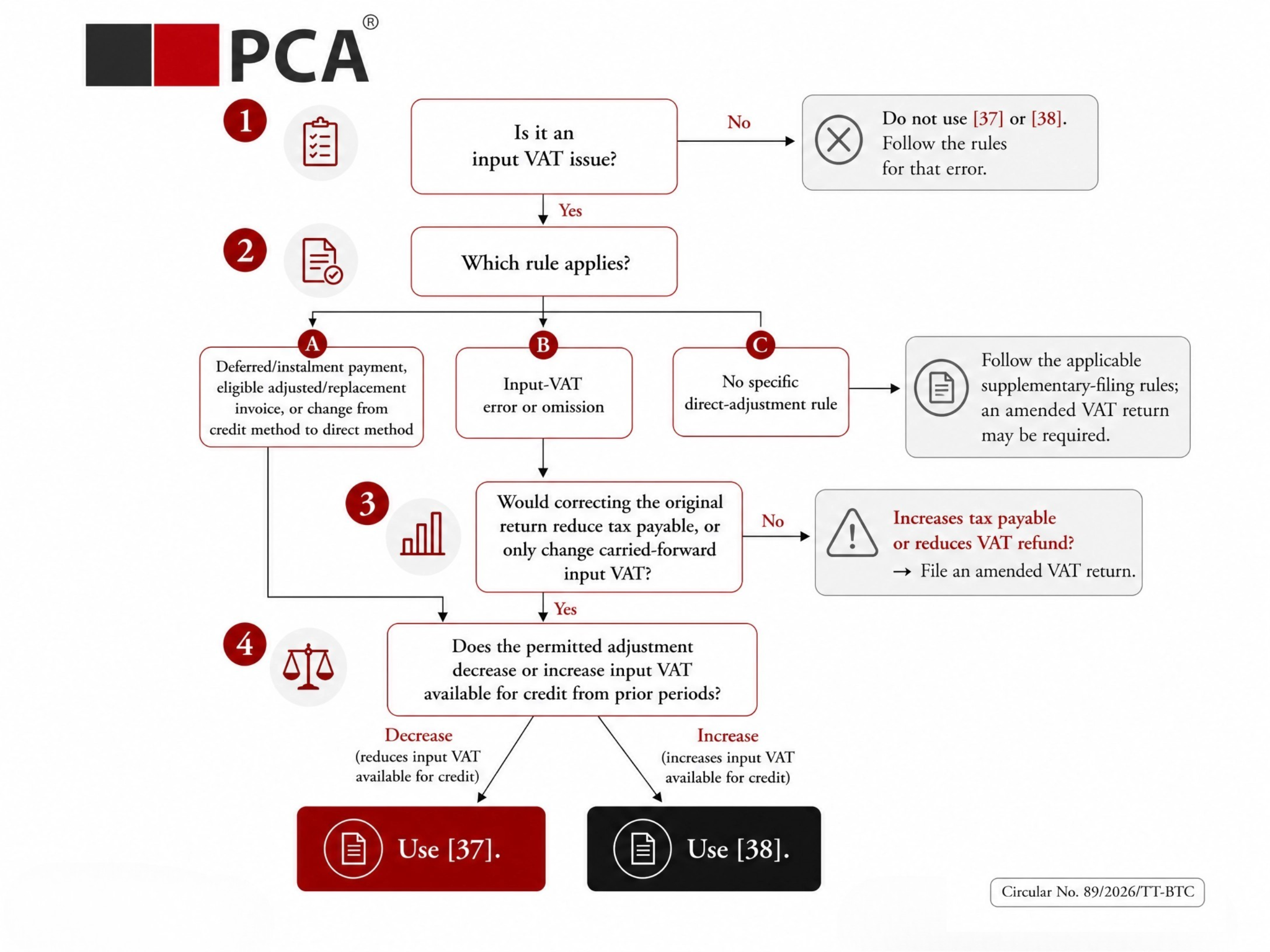
Figure 1: Decision flowchart for evaluating input VAT adjustments under Circular No. 89/2026/TT-BTC. Source: PCA Analysis.
Key Takeaway: Items [37] and [38] provide businesses with more flexibility in handling certain input VAT adjustments. However, the correct treatment depends on the nature of each transaction, supporting documentation and tax impact. Careful accounting assessment remains essential before reporting any adjustment.
III. What Are the Risks of Incorrect VAT Treatment?
VAT adjustments are not isolated accounting entries. Because input VAT balances are carried forward between reporting periods, an incorrect treatment in one quarter may affect subsequent VAT returns.
For businesses, this may result in:
- Differences between VAT declarations and accounting records;
- Difficulty reconciling carried-forward VAT balances;
- Additional time required to review historical transactions and supporting documents;
- Increased complexity when responding to tax authority reviews or inspections.
For example, if an input VAT adjustment is incorrectly reported, the error may continue affecting future VAT periods until it is identified and corrected.
This is why VAT compliance requires more than simply submitting returns on time. Accounting teams need to understand the transaction background, supporting documentation and tax impact before recording adjustments.
IV. Why Does Proactive Accounting Management Matter?
Regulatory changes such as the updated VAT return requirements demonstrate that accounting teams play an important role beyond routine bookkeeping and tax filing.
A proactive accounting function should:
- Monitor relevant regulatory developments;
- Understand how changes apply to actual business transactions;
- Identify potential issues before they affect tax filings;
- Maintain consistency between accounting records and tax declarations; and
- Provide timely information to management for decision-making.
For foreign-owned businesses operating in Vietnam, this is particularly important because local tax and accounting requirements may differ significantly from practices in other jurisdictions.
Having an accounting team that combines technical knowledge with practical business understanding helps companies maintain accurate financial records, manage compliance obligations and reduce unnecessary risks.
PCA Note
The updated VAT requirements highlight a broader point: accounting compliance is not only about completing tax filings, but also about ensuring that businesses have proper processes to identify, assess and manage financial and tax risks.
At PCA, our accounting team proactively monitors regulatory developments and evaluates how changes may affect our clients’ actual transactions, accounting records and tax compliance obligations.
By combining technical knowledge with practical business understanding, PCA supports businesses in:
- Reviewing accounting treatments and tax implications;
- Maintaining accurate and consistent financial records;
- Identifying potential compliance issues at an early stage; and
- Adapting accounting processes when regulatory requirements change.
For businesses operating in Vietnam, having a reliable and proactive accounting function helps management make informed decisions and maintain confidence in their financial reporting.
For further information and tailored consultation on managing accounting and tax compliance requirements under Vietnam’s evolving regulatory environment, businesses may contact PCA to discuss how these changes may impact their operations and how appropriate accounting solutions can be implemented.
Email: info@pca-cs.com
Hotline: +84 (0) 90909 0415 | +84 (0) 909091141
Author: Chief Financial Officer, Mr. Nguyen Quoc Tu
Tags: #VietnamVAT #VATVietnam #VietnamTax #VATReturn #VATCompliance #InputVAT #OutputVAT #TaxCompliance #VietnamTaxLaw #VAT2026 #VietnamBusiness #VietnamAccounting #TaxFiling
— References —
- Circular No. 89/2026/TT-BTC dated 30 June 2026, particularly Appendix I (Form No. 01/GTGT and its instructions) and Appendix II (guidance on supplementary tax filings);
- Decree No. 252/2026/NĐ-CP dated 30 June 2026, particularly Article 12;
- Circular No. 91/2026/TT-BTC dated 30 June 2026, particularly Article 10(5); and
- Law on Tax Administration No. 108/2025/QH15, particularly Article 12.