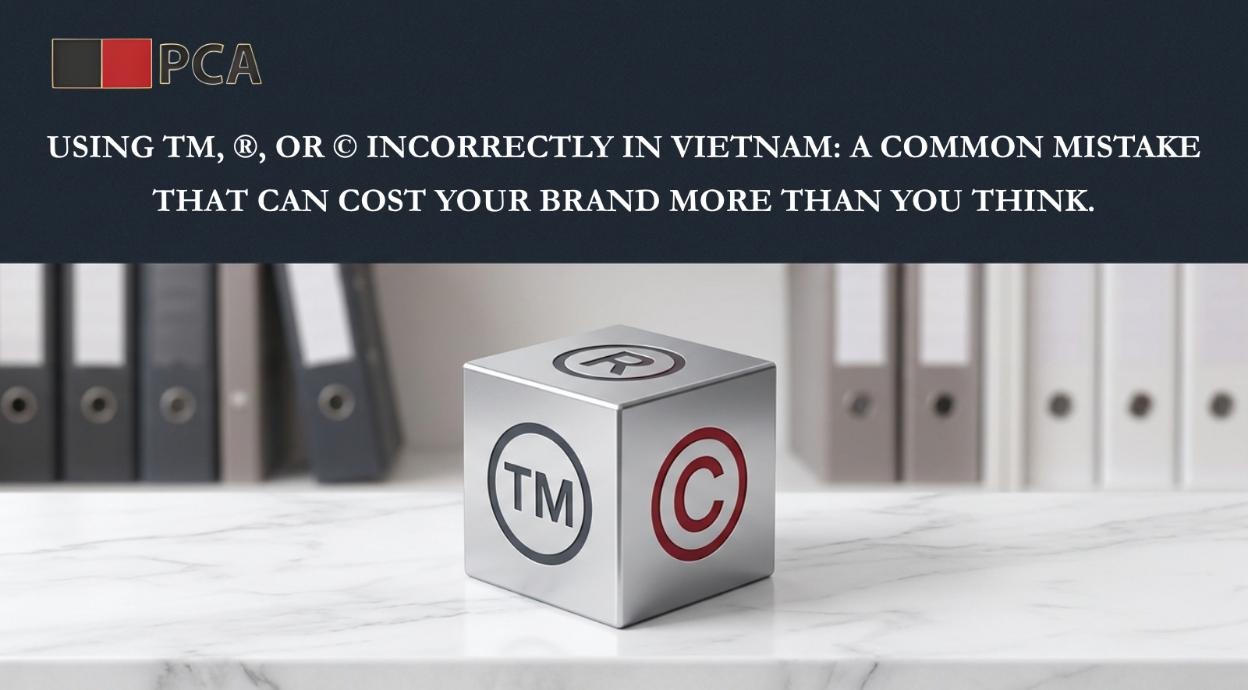
TM, ® or © — Are You Using the Wrong Symbol for Your Brand in Vietnam?
Introduction
In Vietnam, many businesses — particularly startups and foreign entrants — tend to treat trademark symbols like ™, ®, or © mainly as branding elements rather than legal indicators.
In practice, however, these symbols carry specific legal meanings. They indicate whether a brand is registered, simply being used as a trademark, or protected under copyright law.
Because this distinction is not always obvious, it is often overlooked. But as a business grows, works with partners, or enters investment discussions, incorrect use of these symbols can create confusion, misalignment, and credibility risks.
Article Outline
- I. What Do ™, ®, and © Actually Mean
- II. Why Does This Matter for Businesses?
- III. Who Can Register a Trademark in Vietnam — and How the Process Work
- PCA Note
I. What Do ™, ®, and © Actually Mean?
© (Copyright)
The © symbol is generally used for creative works such as designs, content, artwork, books, logos, and other forms of creative expression, provided they meet the legal conditions to qualify as works of applied art.
In Vietnam, copyright protection arises automatically by operation of law once a qualifying work is created and fixed in a tangible form; registration is not mandatory.
This symbol indicates that the owner claims copyright in the work; however, copyright protection itself arises automatically once a qualifying work is created and fixed in a tangible form. It covers both:
- Moral rights (e.g. attribution to the author), and
- Economic rights (e.g. the right to commercially exploit the work).
For example, when used with a logo, the © symbol is often placed near the design (commonly at the bottom corner) to indicate that it is an original creative work, not copied from another source.
Key Takeaway: © protects the creative expression (design, content, artwork).
® (Registered Trademark)
The ® symbol is used for trademarks that have been officially registered and granted a certificate of protection by the competent authority (e.g. the Intellectual Property Office).
Once registered, the trademark owner has exclusive legal rights to use that trademark within the registered goods/services and territory.
The ® symbol may only be used after the trademark has completed registration and been granted valid protection. Importantly, the law strictly prohibits using this symbol for trademarks that have not yet been granted protection.
Key Takeaway: ® means your trademark is officially registered and legally protected.
™ (Trademark)
The ™ symbol is used for signs (such as names, logos, or slogans) that are being used as trademarks but are not yet registered or have not yet been granted protection.
It does not create an independent legal right. Instead, it serves as a notice that the business is using the sign as a trademark and intends to claim rights over it.
In practice, ™ also helps:
- distinguish products or services from competitors, and
- signal to third parties that the brand is being claimed and should not be used without caution.
Key Takeaway: ™ shows you are using a sign as a trademark, but it is not yet registered.
II. Why Does This Matter for Businesses?
At a practical level, trademark symbols are not only about communication — they affect how your rights are interpreted and enforced when it matters most.
Many businesses assume:
- “I created the logo, so I am protected.”
- “Using ® strengthens the brand.”
In reality, these assumptions can create gaps between what the business believes it owns and what it can actually rely on in practice.
1. The real risk appears only when something goes wrong
In day-to-day operations, incorrect symbol usage may not cause immediate issues. However, when a situation arises — such as:
- a competitor using a similar brand,
- a dispute over ownership, or
- a need to formally prove rights
The business may face a key question: “What can actually be enforced, based on the current legal status?”
If the symbols used do not reflect the real legal position:
- expectations may be higher than the actual protection available
- enforcement may be slower or more limited than anticipated
2. It can affect how smoothly issues are resolved
In practice, legal protection is not only about having rights — it is about how efficiently those rights can be exercised.
When trademark status is unclear or inconsistent:
- additional clarification may be required
- documentation may need to be rechecked or supplemented
- timelines for resolution may become less predictable
This can create unnecessary friction, especially in situations that already require speed and clarity.
3. It may limit flexibility in future business actions
As a business evolves, trademarks are often used in:
- licensing arrangements
- franchising structures
- expansion into new markets
- transfer or restructuring of ownership
If the legal status of the trademark is not properly aligned from the beginning:
- certain options may become more complex to execute
- adjustments may be required before moving forward
- internal alignment may need to be revisited
Key Takeaway: Using them without alignment to the actual legal status may not create immediate problems, but it can reduce clarity, slow down execution, and limit flexibility when the business needs to act with confidence.
III. Who Can Register a Trademark in Vietnam — and How the Process Works
Understanding trademark symbols is only one part of the picture. In practice, what matters more is how a trademark is registered, who can register it, and what the process involves.
1. Who can register a trademark?
In Vietnam, trademark registration is available to:
- Vietnamese individuals and companies
- Foreign individuals and companies
- Both local and international applicants
Foreign applicants are generally required to file through a licensed local representative.
The applicant must be the legitimate owner of the trademark or have a lawful connection to the goods/services associated with it.
2. What is a “class” in trademark registration?
When you register a trademark in Vietnam, you are not protecting your brand for “everything”.
Instead, protection is granted based on specific categories of goods or services, called “classes”, under the international Nice Classification system (currently including 45 classes).
- Classes 1–34: Physical goods (e.g. Class 25 – clothing; Class 3 – cosmetics)
- Classes 35–45: Services (e.g. Class 35 – retail/advertising; Class 43 – restaurants/hospitality)
When filing a trademark, businesses must select the correct class(es) based on their actual activities. A trademark is only protected within the registered class(es). For example, registration in Class 25 (clothing) does not automatically cover Class 35 (retail).
Key Takeaway: Trademark protection is not “one-size-fits-all” — it is limited to the classes registered.
3. How long is a trademark protected?
- Protection lasts 10 years from the filing date
- It can be renewed indefinitely every 10 years
4. What is the typical cost?
Trademark registration in Vietnam typically starts from:
- ~USD 500 for 1 class
The total cost will increase depending on:
- number of classes
- complexity of the application
5. What documents are required?
A standard application usually includes:
- Trademark sample (logo / word mark)
- List of goods/services (classified correctly)
- Applicant information (individual or company)
- Power of Attorney (for foreign applicants or representation)
6. What is the typical timeframe?
Trademark registration is a structured process and typically takes:
- 12 to 18 months
This includes:
- formal examination
- publication
- substantive examination
- possible clarification or objections
Legal protection under ® only applies after successful registration.
Key Takeaway: Trademark registration in Vietnam is class-based, time-based, and document-driven — and proper preparation from the beginning helps ensure smoother protection and future use.
PCA Note
From PCA’s experience, the issue is not whether businesses understand what ™, ®, or © mean — but whether these symbols are managed as part of a broader intellectual property structure.
In practice, many businesses develop their brand first, and only later revisit how it is legally positioned. During early stages, this may not create visible constraints. However, as the business grows – particularly when entering more structured phases such as partnerships, licensing, or investment – the level of internal alignment becomes more relevant.
At that point, trademark-related elements are no longer viewed in isolation. They are considered together with:
- ownership structure of the brand,
- registration status across jurisdictions,
- consistency in usage across contracts, materials, and operations, and
- the ability to demonstrate clear control over intangible assets
From PCA’s perspective, businesses that address these elements early tend to operate with greater clarity when scaling or engaging with external parties. The focus is not on the symbols themselves, but on whether the business can present a coherent and well-documented position when required.
Conversely, when alignment is addressed only at a later stage, it often involves revisiting existing materials, clarifying ownership, and restructuring documentation — which can be more time-sensitive and operationally demanding.
For this reason, PCA generally approaches trademark matters not as a standalone registration task, but as part of a broader structuring process — ensuring that brand usage, legal status, and business objectives are aligned from the outset.
For further information about intellectual property structuring, trademark registration, and practical compliance support in Vietnam, businesses may contact PCA for customized consultation.
Email: info@pca-cs.com
Hotline: +84 (0) 90909 0415 | +84 (0) 909091141
Author: Chief Legal Officer – Trương. M. Đ. Thư
Tags: #TrademarkVietnam, #IPCompliance, #TrademarkSymbol, #TMvsR, #CopyrightVietnam, #BusinessCompliance, #BrandProtection, #IntellectualProperty, #ForeignInvestmentVietnam, #LegalRiskManagement