
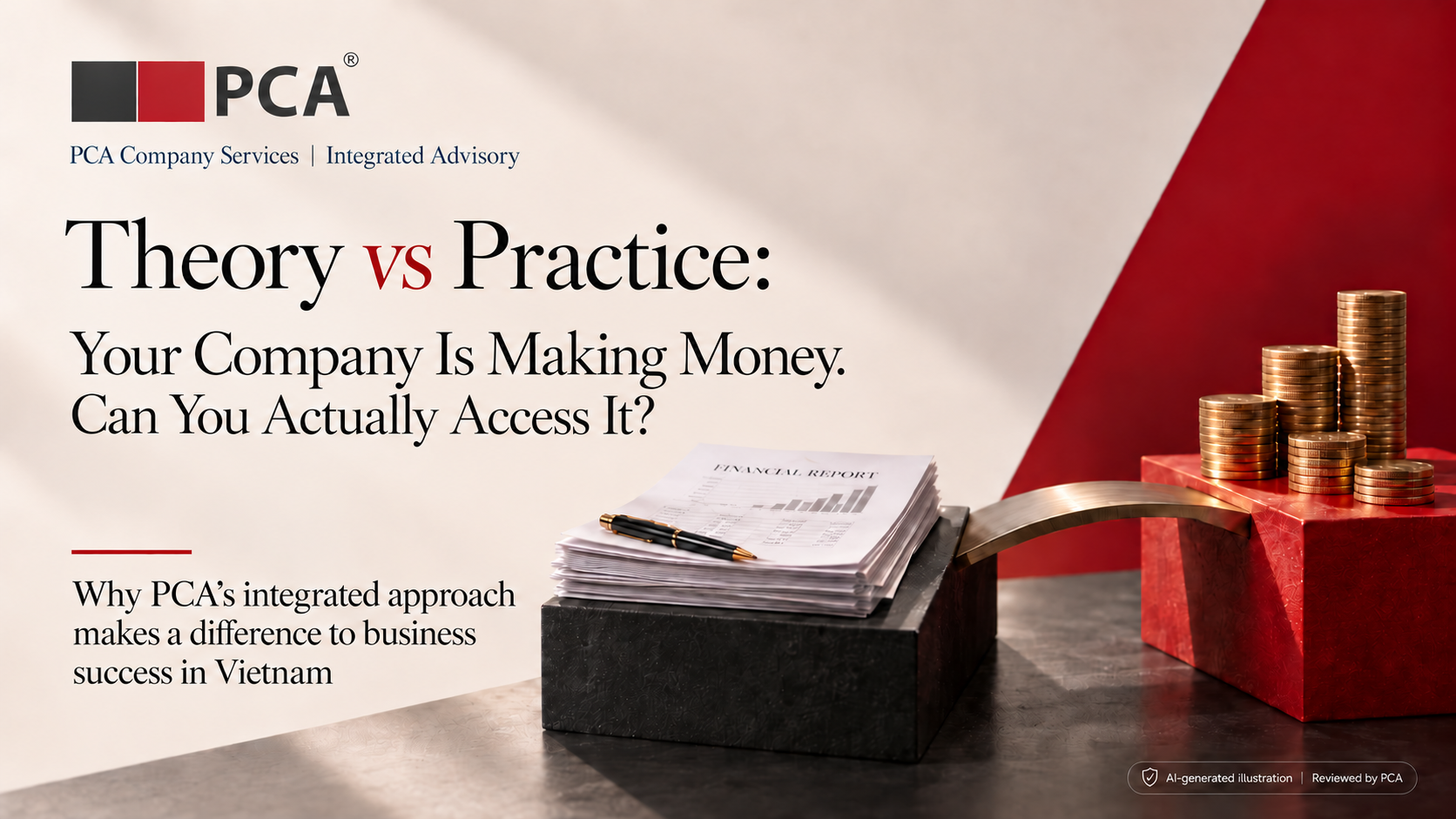
Theory vs Practice: Your Company Is Making Money. Can You Actually Access It?
Introduction
Why PCA’s integrated approach makes a difference to business success in Vietnam
Incorporating a company is not an end in itself. The objective is to develop a business, generate profits and be able to put those profits to use. It is precisely when a company is performing well that the quality of its structure becomes critical.
In Vietnam, the law allows profits to be transferred abroad, subject to certain conditions. A blocked transfer does not necessarily mean that the country prevents investors from accessing their money. It may reveal an arrangement that was never thought through from beginning to end.
At PCA, our conviction is simple: a successful business deserves more than a succession of correctly executed services. It needs a coherent whole.
Article Outline
- I. Knowledge and Understanding: The Difference Is Measured in Results
- II. Integration Versus Disintegration
- III. PCA: Specialist Generalists, Working for Your Success
I. Knowledge and Understanding: The Difference Is Measured in Results
In our profession, we distinguish between knowledge — knowing what a rule says — and understanding — knowing how to apply it to a real situation, with its constraints and consequences.
Knowing how to incorporate a company does not necessarily mean understanding why it should be established, how to finance it, structure its tax arrangements, distribute its profits or prepare for its eventual sale. Understanding how to close a company is also valuable from the outset: not to anticipate failure, but to preserve the investor’s future options.
Acquiring knowledge is therefore not simply a matter of accumulating legal texts. It requires testing that knowledge against experience, business operations and documentation requirements.
This transformation of knowledge into practical understanding is never about circumventing the rules. It is about making their application work in practice.
|Company A: the profits are there, but the transfer must wait
The following two case studies are fictional illustrations. They do not describe actual clients.
Company A, owned by a foreign investor, appoints a specialist provider to handle its incorporation. The necessary approvals are obtained. Operations begin, and the business becomes profitable.
At the outset, however, funds intended as capital contributions are sent to an ordinary operating account, without being routed through the required investment account. They are used to cover initial expenses. The banking records, accounting entries and corporate documents are never reconciled. Yet, for companies subject to these requirements, cash capital contributions must follow a regulated banking process.
A few years later, Company A has cash available and USD 300,000 in accumulated profits. The investor wants to receive a distribution. In this scenario, the bank requests clarification of the historical transfers and their classification before processing the payment.
This verification is not merely a formality: banks must review supporting documents and ensure that foreign exchange transactions comply with applicable requirements. A resolution approving a distribution does not replace a consistent set of banking records.
It would be excessive to claim that every irregularity in a capital contribution permanently prevents dividend payments. However, improperly executed funding may require corrective action and delay access to profits.
PCA’s approach is to plan for the transfer of profits from the moment capital enters the business: establish the nature of the funds, organise their movement, reconcile the supporting evidence and prepare distributions in coordination with the legal and accounting teams and the bank.
|Company B: a genuine expense, an illusory tax saving
Company B is growing rapidly. Its overseas parent company provides IT and commercial support, invoiced at USD 100,000 per year.
An adviser prepares the contract. The accountant records the invoices. The services are genuinely delivered. Everyone considers their task complete.
But no one establishes a process for retaining service records, substantiating the services received or documenting how costs are allocated between subsidiaries. During a tax inspection, Company B cannot adequately substantiate the commercial basis and amount of the expenses it has deducted.
Vietnam’s rules on intragroup services require, among other things, an economic benefit for the recipient company, arm’s-length pricing and appropriate documentation. A contract and an invoice are therefore not, by themselves, sufficient to secure tax deductibility.
In this example, the inadequately substantiated expenses are added back to taxable income. Company B has paid for the services but faces a higher tax bill than anticipated, followed by additional professional fees to address the problem.
An integrated approach would have connected the contract, the services actually delivered, their pricing, the evidence to retain and their tax treatment before the first invoice was issued.
Tax optimisation is not about inventing expenses. It is about organising genuine transactions correctly.
II. Integration Versus Disintegration
Neither of these companies suffers from a shortage of customers. They suffer from a disconnect between interdependent decisions.
This is the issue at the heart of integration versus disintegration: when everyone optimises their own area without checking the consequences elsewhere, a series of individually sound answers can produce a collectively unsatisfactory outcome.
The problem is not specialisation, which is essential. It is the absence of coordination. A firm’s size or reputation does not remove the need to establish who is responsible for ensuring that everything fits together.
Everyone does their best with the resources available to them. But resources, experience and methods are not equivalent. Good intentions cannot replace an appropriate organisational approach.
III. PCA: Specialist Generalists, Working for Your Success
For ten years, PCA has built its approach around this conviction. Our services bring together corporate structuring, legal advice, compliance, taxation, accounting and human resources management.
We describe ourselves as specialist generalists: professionals with in-depth expertise in their respective disciplines, working within a comprehensive understanding of the business.
Integration is not simply placing several services under the same brand. It means working from the same facts, examining recommendations across disciplines and following their consequences through to execution.
The point is not to suggest that Vietnam presents no regulatory challenges. It is to distinguish genuine constraints from obstacles created by inadequate preparation. Paying repeatedly to correct a poorly designed transaction should not become evidence that the country is inherently too expensive or too difficult to do business in.
For a profitable company, the relevant question is therefore not simply: “How much does advice cost?” It is also: “How much am I paying for what no one thought to coordinate?”
|PCA: Connecting expertise so your success does not remain confined to your accounts.
Email: info@pca-cs.com
Hotline: +84 (0) 90909 0415 | +84 (0) 909091141
Author: Mr. Lê N. Bao, Group CEO – PCA
Tags: #ProfitRepatriation, #ProfitRemittance, #VietnamBusiness, #ForeignInvestment, #VietnamTax, #CorporateCompliance, #TransferPricing, #BusinessStructuring, #ForeignInvestors