
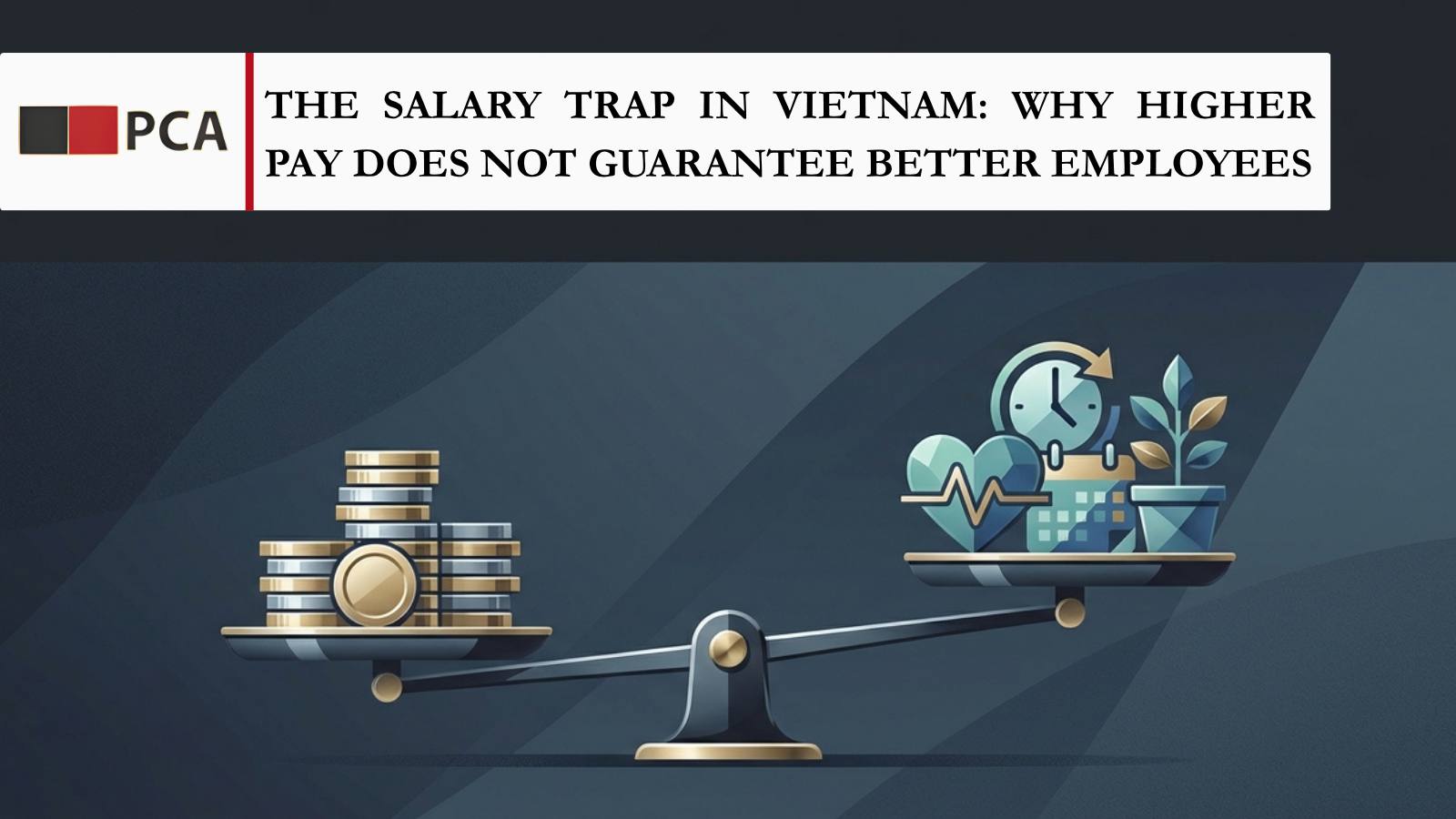
The Salary Trap in Vietnam: Why Higher Pay Does Not Guarantee Better Employees
Introduction
Across Vietnam’s labor market, many employers are facing a familiar challenge: salary expectations are rising, yet higher payroll costs do not always lead to stronger employee retention. This is especially noticeable when hiring and managing younger employees.
Many businesses still focus first on the salary figure, assuming that a more competitive offer should be enough to attract and keep talent. In reality, salary remains important — but today’s young workforce is often looking at the whole package, not just the monthly pay.
This means employers should think beyond salary alone and consider the broader employment structure: compensation and benefits, all developed within a proper company culture. In practice, this is often where retention becomes more sustainable. A strong employment offer is not simply about paying more — it is about creating the right balance and incentives.
Article Outline
- I. Why Salary Still Matters — But No Longer Tells the Whole Story
- II. What Today’s Young Workforce Is Looking At Beyond Salary
- III. Why Higher Payroll Costs Do Not Always Improve Retention
- PCA Note
I. Why Salary Still Matters — But No Longer Tells the Whole Story
Compensation remains one of the foremost factors of interest for young candidates, and employers should continue to take prevailing market expectations into careful consideration. If the salary proposed for a given position is significantly lower than the general market benchmark within the relevant industry salary range for that role, recruitment efforts may become challenging. In such cases, job offers are likely to be less competitive and may not be sufficiently attractive to secure high-potential candidates.
However, an exclusive focus on fixed salary may create short-term pressure without effectively addressing the longer-term challenge of employee retention. A more effective approach is to adopt a holistic view of total compensation and benefits, rather than considering base salary in isolation. This entails designing an optimal fixed salary structure, complemented by well-calibrated bonus mechanisms, benefits and entitlements, as well as both financial and non-financial support. Such a framework should be thoughtfully aligned with performance outcomes, the specific nature of each role within its respective industry, the company’s culture, and prevailing industry standards.
When compensation and benefits are structured this way, employees can better understand both stability and growth potential. It also gives employers more flexibility than simply increasing fixed payroll costs across the board.
Key Takeaway: Young talent still expects competitive pay, but employers should think in terms of a balanced compensation structure — not salary alone.
II. What Today’s Young Workforce Is Looking At Beyond Salary
Today’s younger workforce is often evaluating employers through a broader lens. In addition to compensation, they are paying closer attention to benefits and the overall employee experience.

These benefits may include:
- Entertainment and team engagement
- Training and skills development
- Mentoring and management support
- Education opportunities
- Other practical benefits that improve the work experience
For many young employees, these elements signal whether a company is investing in them beyond the payslip. In practice, this often has a direct influence on engagement, motivation, and retention.
Key Takeaway: Younger employees are increasingly evaluating the full employment experience — including both compensation and benefits, not just the salary figure on the offer letter.
III. Why Retention Depends on Balance, Incentives, and Company Culture
Even a well-designed package may not be effective if it is not supported by the right internal environment. Compensation and benefits should be developed within a proper culture, based on the values of the company, which are often closely linked to the values of the business owner(s).
This is where retention becomes more than a payroll question. Employees are more likely to stay when they feel that incentives are fair, expectations are clear, and the company culture supports both performance and personal development.
In practical terms, the most sustainable approach is usually not the highest salary offer, but the right balance between fixed pay, performance incentives, meaningful benefits, and a workplace culture that feels consistent and credible.
Key Takeaway: Long-term retention is often built on the right balance of compensation, incentives, benefits, and company culture — not salary alone.
PCA Note
Over the past decade, PCA has observed a recurring pattern in the Vietnamese market, particularly among startups and foreign-invested companies: many employers, often unconsciously, attempt to transfer the mindset of an entrepreneur or business owner onto employees. In practice, however, an employee is not necessarily driven by the same logic, level of ownership, tolerance for risk, or performance reflexes as a founder. This often creates a structural mismatch from the beginning of the employment relationship and leads to unrealistic expectations on both sides.
One of the most common assumptions in the market is that a higher salary will automatically generate better quality, stronger performance, or greater commitment. In reality, compensation alone does not unlock skills that are not yet there, nor does it compensate for a lack of experience, discipline, technical depth, or professional maturity. At the same time, employees who are offered salaries above their actual market-fit level may begin to believe that the level of pay received is itself proof of competence. This can create a dangerous misunderstanding, where salary becomes disconnected from actual capability.
PCA has also seen that, as Vietnam continues to attract an increasing number of foreign-invested companies, many local employees are fully aware that these employers often arrive with higher salary budgets and greater flexibility on compensation. In practice, this has contributed to what is commonly referred to on the market as a form of “foreign company tax,” where external or foreign-invested employers are expected to pay substantially more simply because they are perceived as having deeper pockets. Very often, this results in salary packages being inflated by approximately 30% to 100% above normal local base salary levels for similar roles.
Over the years, PCA has observed, very frequently — if not in the majority of cases — that the highest-paid staff members are not necessarily the most competent, but sometimes the least competent. This is where the snowball effect becomes particularly problematic. Once an employee receives an inflated salary disconnected from actual market value or real skill level, that salary may reinforce the belief that they are highly capable, even where the underlying performance does not support that conclusion. In some cases, this dynamic resembles the well-known Dunning-Kruger effect: individuals with lower competence may overestimate their own ability, and an inflated compensation package can further strengthen that misperception. As a result, the employee may believe they deserve not only the current salary, but an even higher one, without the corresponding development in skills or output.
This creates a cycle of misalignment. Employers believe they have already fulfilled their part by paying well above market and therefore expect immediate quality, reliability, and ownership. Employees, on the other hand, may interpret the high salary as validation of a level they have not yet operationally reached. The result is frustration on both sides. In startup environments especially, this often leads to rapid job-hopping, with employees moving from one company to another after only a few months in search of ever-higher pay, while failing to accumulate meaningful experience, long-term discipline, or stable professional growth. By the age of 30 or 35, some candidates may present highly inflated salary histories and frequent changes on their CV, but with limited concrete achievements or real depth of execution.
For this reason, PCA generally recommends that employers remain aligned with realistic market standards for base salary, while structuring any amount above market level through carefully designed incentives, performance bonuses, or conditional rewards. This approach helps preserve internal fairness and ensures that additional compensation is linked to measurable effort, results, and alignment. It also sends a much healthier message from the start: long-term income growth is built through performance, consistency, and contribution, not through inflated expectations alone. Once that logic is properly understood by the employee, there is usually a much stronger basis for retention, trust, and long-term career planning.
As salary expectations continue to evolve, many employers are also realizing that young talent no longer evaluates a job based on pay alone. Stronger retention often comes from building the right balance between compensation, incentives, employee benefits, management quality, and a company culture that genuinely reflects the values and operating reality of the business.
With experience supporting both local and foreign-invested companies in Vietnam, PCA assists employers in approaching HR and payroll matters with a practical and structured perspective, helping businesses align compensation design, employee benefits, and day-to-day workforce management in a way that is both operationally realistic and compliant.
It should also be noted that the above observations address only one part of the equation, namely employee well-being, human resources structuring, and workforce development. They do not yet cover the broader accounting, tax, payroll structuring, and optimization considerations involved in employment in Vietnam, including the various frameworks, incentives, and government-driven mechanisms designed to support the hiring and development of Vietnamese employees in the context of a developing economy.
For further information about HR and payroll support services in Vietnam, businesses may contact PCA for customized consultation.
Email: info@pca-cs.com
Hotline: +84 (0) 90909 0415 | +84 (0) 909091141
Author: CEO of PCA Group, Le N. Bao and Head of HR & Payroll, Mrs. Trương T. N. Hà
Tags: #GenZworkforceVietnam #younglabormarketVietnam #employeeretentionVietnam #compensationandbenefitsVietnam #payrollstrategy #HRservicesVietnam #HRandpayrollcompliance