
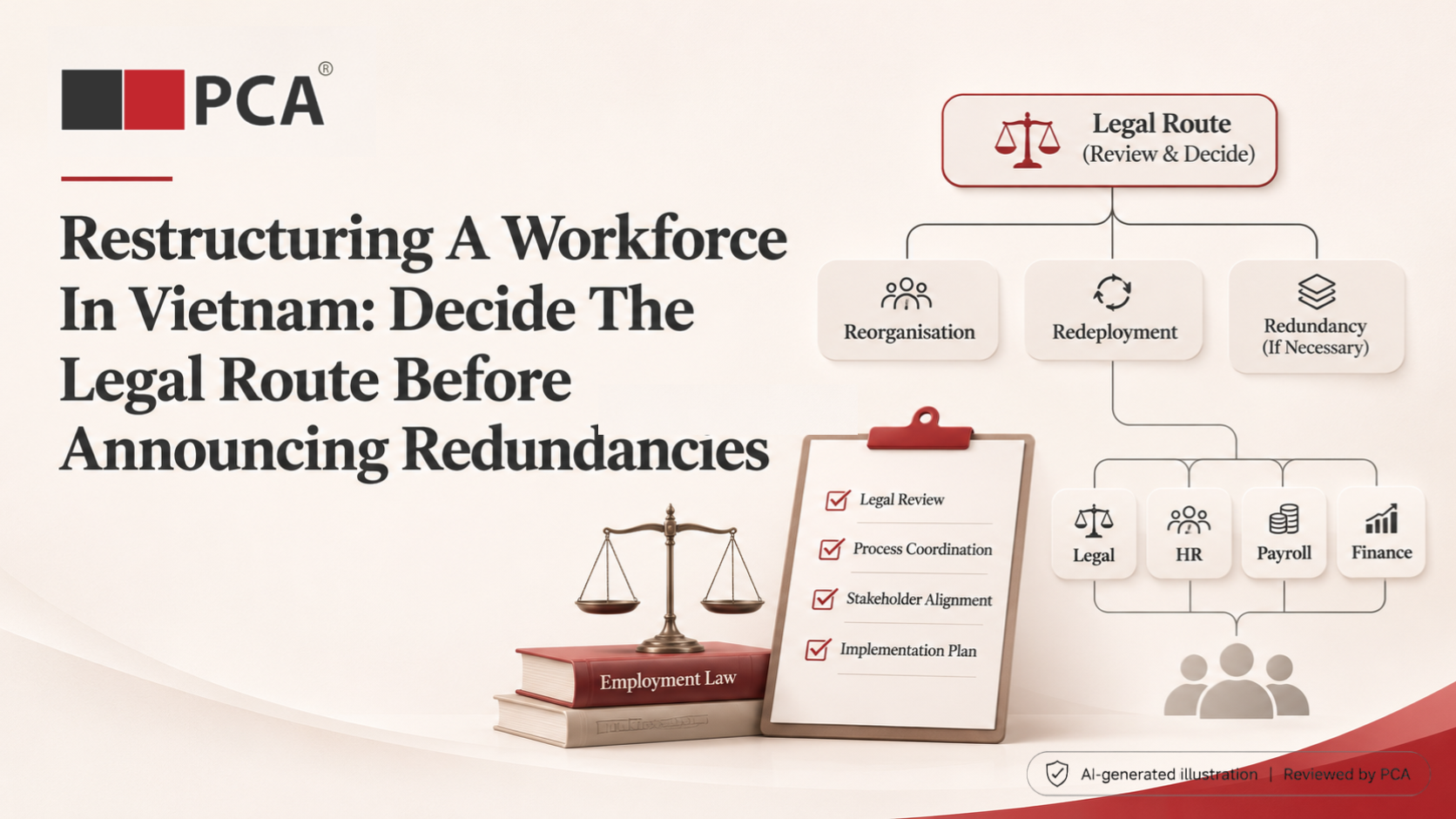
Restructuring a Workforce in Vietnam: Decide the Legal Route Before Announcing Redundancies
During the course of its operations, a company may implement changes to its organisational structure, technology, or business operations that affect employees' jobs. Where such changes may result in employment terminations, the employer must identify the applicable legal grounds and comply with the corresponding obligations under the Labour Code.
That sequence reverses the decision that matters. A reduction in budget is not, by itself, a legal classification of every employee's departure. The route chosen affects the evidence the employer needs, the process it must follow, the payments owed and the risk of a dispute. For established businesses approaching the 2026 year-end, an integrated review is more useful than a single severance-cost estimate.
Article Outline
- I. Start With The Reason, Not The Number Of Employees
- II. A Workforce Plan Is A Decision Document, Not A Formality
- III. Calculate The Whole Exit, Not Just A Headline Allowance
- IV. Communicate Only After The Facts And Responsibilities Align
- PCA Note
I. Start With The Reason, Not The Number Of Employees
Vietnam's Labour Code, Law 45/2019/QH14, as reflected in the consolidated text issued in February 2026, distinguishes restructuring and technological changes, economic reasons, enterprise transactions, individual unilateral termination and termination by agreement. These mechanisms should not be treated as interchangeable.
Under Article 42, structural or technological changes and specified economic circumstances may trigger a workforce-use process. Article 43 addresses workforce consequences of mergers, divisions, transfers and certain other enterprise changes. Article 44 sets requirements for the labour utilisation plan. The employer must identify the actual legal circumstances, rather than simply describe an ordinary business decision as an economic crisis.
A downturn in a department, the disappearance of a particular role and the sale of a business unit can therefore require different analyses. Where structural or technological changes create new jobs, Article 42(3) requires the employer to prioritise retraining existing employees for continued employment. An internal organisation chart and financial projection may support management's explanation, but neither replaces the legal conditions.
A hypothetical example illustrates the distinction. A company decides to replace a manual reporting function with software while retaining its customer operations. It should examine the actual change in duties, potentially affected positions and retraining options. It should not assume that every employee in the department becomes redundant automatically because the technology budget was approved.
II. A Workforce Plan Is A Decision Document, Not A Formality
Where Articles 42 or 43 require a labour utilisation plan, Article 44 describes its contents: employees to be retained, retrained or moved to part-time work, those retiring or leaving, associated rights and obligations, and measures and funding for implementation. Article 44 requires consultation with the workplace employee representative organisation, where one exists, while preparing the plan, and public communication of the plan within 15 days after adoption.
Separately, Article 42(6) requires consultation with the workplace employee representative organisation of which affected employees are members, where applicable, and at least 30 days' advance notice to the provincial People's Committee and affected employees before termination under Article 42. This rule must not be treated as a universal notice period for every termination route.
Management should establish the plan before communicating individual outcomes. Otherwise, employees may receive inconsistent explanations, salary or insurance calculations may be wrong, and the business may struggle to demonstrate that the decision reflected a genuine organisational need.
Legal should test the ground and process. HR should verify the workforce history and the operational alternatives. Payroll should reconcile accrued wages, leave and insurance records. Finance should budget the transition and not merely the expected reduction in monthly salaries. These are dependencies in one decision, not separate approvals performed after the announcement.
III. Calculate The Whole Exit, Not Just A Headline Allowance
The Labour Code distinguishes severance allowance from job-loss or redundancy allowance. Article 47 provides, in eligible qualifying cases, a redundancy allowance generally calculated at one month's salary for each qualifying year of work, with a statutory minimum of two months' salary. The qualifying service period is adjusted for unemployment-insurance participation and periods already compensated; the reference salary is based on the contract's average over the final six months. Eligibility requires at least 12 months of regular service with the employer and a qualifying job-loss termination. Under Article 8(2) of Decree 145/2020/ND-CP, the two-month minimum still applies where the service period used for calculation, after statutory deductions, is less than 24 months. The service required for eligibility must be distinguished from the period used to calculate the allowance.
A negotiated termination may have different contractual and statutory consequences. So may a lawful unilateral termination on a different ground. Treating all exits as if they generate the same compensation will distort both the employee communication and the forecast.
The company must also settle final wages and benefits and complete relevant employment and insurance administration. Article 48 normally requires settlement within 14 working days after termination. In its specified exceptional cases, including restructuring and relevant enterprise transactions, this may be extended to no more than 30 days. Tax treatment of payments, unused leave and any agreement-specific benefits should be reviewed rather than guessed from the gross amount on an HR spreadsheet.
For foreign employees, check immigration and sponsorship consequences separately. Ending employment may affect work-authorisation and residence planning, but those changes should not be represented as automatic or identical for every expatriate. Personal information in the exit file must remain restricted to those handling the process.
IV. Communicate Only After The Facts And Responsibilities Align
A defensible process can be organised around one decision paper. Record the business rationale and supporting evidence; map affected roles; consider redeployment and retraining; identify the lawful route; define consultation and notices; calculate employee-by-employee entitlements; and assign the owner of each filing, payment and access change.
Before announcing decisions, test the narrative against the documents. Does the financial explanation match the roles affected? Does the plan match the headcount list? Can Payroll reproduce every calculation? Are managers trained not to promise a payment or departure date that has not been approved? Are the access and confidentiality arrangements proportionate?
A labour dispute is not necessarily caused by an employer changing direction. It can arise because the organisation cannot explain why a particular employee was treated as it was, or because the steps documented later do not match what actually occurred.
The practical objective is therefore neither to delay every hard decision nor to disguise it as a voluntary departure. It is to select the legally supportable route, make its financial and human consequences visible, and execute it consistently.
PCA Note
Workforce restructuring is not solely an employment-law exercise. It involves decisions that affect legal compliance, workforce planning, financial commitments, payroll, tax and, in some cases, immigration and corporate arrangements.
PCA supports businesses in coordinating these considerations before and during the restructuring process. By bringing together labour-law analysis, HR planning, payroll and tax review, and relevant corporate considerations, PCA helps management assess the implications of different exit arrangements, establish a consistent implementation plan and identify potential compliance gaps before decisions are communicated.
The objective is to help businesses approach workforce changes with a clear legal basis, properly assessed financial obligations and coordinated execution across the relevant functions.
Email: info@pca-cs.com
Hotline: +84 (0) 909 090 415 | +84 (0) 909 091 141
Tags: #VietnamLabourLaw #WorkforceRestructuring #EmployeeRedundancy #EmploymentTermination #LabourCode #JobLossAllowance #SeveranceAllowance #HRCompliance #VietnamCompliance
Legal Basis
Labour Code No. 45/2019/QH14, dated 20 November 2019, as consolidated in Consolidated Document No. 18/VBHN-VPQH, dated 12 February 2026, particularly Articles 42–48 (Consolidated Document No. 18/VBHN-VPQH).
Decree No. 145/2020/NĐ-CP, dated 14 December 2020, particularly Article 8(2), concerning the minimum job-loss allowance (Decree No. 145/2020/NĐ-CP).