
Expanding from Vietnam to Hong Kong: How PCA Helps Businesses Get Their Documents Ready for Overseas Use
For foreign investors, international business owners and Vietnamese companies operating in Vietnam, Hong Kong can be a natural next step – whether for a regional holding structure, a new company, an investment, an acquisition, a banking arrangement or a cross-border commercial relationship.
The commercial opportunity may be clear. The practical difficulty often begins with the documents prepared in Vietnam.
A document that is valid in Vietnam is not necessarily ready for use in Hong Kong in the form in which it was issued. Before it is signed, translated, submitted or relied upon, the business should identify the precise formality required for its intended use.
Depending on the document’s legal nature, the timing of submission and the requirements of the relevant Hong Kong receiving party, this may involve certification, notarisation, consular legalisation or another applicable authentication step.
Article Outline
- I. When Are Vietnamese Documents Needed in Hong Kong?
- II. How Is the Correct Vietnam Authentication Route Identified?
- III. Which Vietnamese Documents May Be Required for a Hong Kong Business Step?
- PCA Note
I. When Are Vietnamese Documents Needed in Hong Kong?
Document requirements commonly arise when a Vietnamese business or individual needs to demonstrate legal existence, ownership, a corporate decision, signing authority, financial standing or personal identity in Hong Kong.
For an investment or company-expansion matter, typical situations include:
- Establishing, funding or restructuring a Hong Kong company;
- Investing in, acquiring or becoming a shareholder of a Hong Kong business;
- Opening, maintaining or updating a Hong Kong corporate bank account;
- Appointing a director, shareholder representative, authorised signatory or attorney;
- Signing an investment, acquisition, financing, distribution, service or other commercial agreement;
- Demonstrating the authority of a Vietnamese company to approve or enter into a transaction;
- Completing KYC, due-diligence, beneficial-ownership or source-of-funds reviews;
- Providing documents to an auditor, investor, legal adviser, accountant or other professional adviser; and
- Supporting a visa, work, residence or personal-status matter connected with the business step.
For example, a Hong Kong bank may need to confirm that a Vietnamese company exists, who owns or controls it, and who has authority to open or operate an account. A Hong Kong counterparty may require a resolution approving an acquisition or a Power of Attorney in a prescribed form.
Key Takeaway: Document formalities should be identified at the beginning of the transaction. A late issue with certification, legalisation, translation or signing authority can delay a banking, closing or filing timetable.
II. How Is the Correct Vietnam Authentication Route Identified?
There is no single fixed procedure for every Vietnamese company, commercial or personal document. The right route should be determined by assessing:
- What is the document? Is it issued by a Vietnamese authority, prepared by a company, signed by an individual or a certified copy?
- What is its legal nature? Is it a public document, or a private or commercial document that may require a preliminary formality before it can be authenticated?
- Who will receive it in Hong Kong? The relevant bank, authority, counterparty, professional adviser or other receiving party should be identified.
- What is the intended purpose? Company incorporation, investment, banking, regulatory filing, KYC, contract signing and visa matters can involve different requirements.
- When will it be used? The applicable route can depend on the legal framework in force at the time of submission, and a recipient may require a recently issued document.
1. Certification or Notarisation in Vietnam
Some documents may need to be certified, notarised or otherwise formally executed before they can be used abroad.
This can be relevant to:
- Powers of Attorney;
- Board, Member Council or shareholder resolutions;
- Corporate declarations;
- Certified true copies of company records;
- Documents confirming the authority of a legal representative or authorised signatory;
- Contracts and commercial documents; and
- Personal declarations, identity documents or supporting records.
However, not every document requires notarisation before a further authentication step. The required preliminary formality depends on the document’s nature, issuer, form and the requirements of the Hong Kong receiving party.
For example, an original certificate issued by a competent Vietnamese authority may require a different assessment from a board resolution prepared by a company. Similarly, a bank may ask for a certified copy and proof of authority, while a transaction counterparty may require a resolution or Power of Attorney to be formally executed in a particular way.
2. Consular Certification, Consular Applications and Consular Stamps
For Vietnam-issued documents intended for use in Hong Kong before 11 September 2026, the applicable route should be assessed under Vietnam’s current consular certification framework, together with the requirements of the Hong Kong receiving party. Vietnam’s framework is set out in Decree No. 111/2011/NĐ-CP. Official text of Decree No. 111/2011/NĐ-CP
Under Vietnamese regulations, consular certification applies to Vietnamese documents and papers for recognition and use abroad, while consular legalisation applies to foreign documents and papers for recognition and use in Vietnam.
Depending on the document and its intended use, the process may involve preparing a consular application and obtaining the appropriate consular certification endorsement or stamp from the competent Vietnamese authority.
This may be relevant for:
- Hong Kong company-incorporation or shareholder matters;
- Investments, acquisitions and capital-contribution arrangements;
- Corporate banking, KYC and beneficial-ownership reviews;
- Licensing, tax or regulatory submissions;
- Powers of Attorney and authority documents; and
- Contracts or other corporate records required by a Hong Kong counterparty.
The correct route should not be assumed. The relevant document set, translation requirements, prior certification or notarisation requirements, and the receiving party’s stated requirements should be confirmed first.
The first question is not “How do we obtain an Apostille or authentication stamp?” It is “What is this document, what formality does it require, and what will the Hong Kong recipient accept?”
3. Apostille for Documents Used after 11 September 2026
Vietnam’s accession to the 1961 Apostille Convention will enter into force on 11 September 2026. For documents intended for use in Hong Kong on or after that date, the applicable route should be rechecked against the document’s legal nature, the relevant scope and the receiving party’s requirements. HCCH—Vietnam’s accession to the Apostille Convention
An Apostille is intended to facilitate the use of public documents abroad where the Convention applies. It does not mean that every Vietnam-issued company, commercial or personal document can automatically receive an Apostille.
Businesses should therefore confirm:
- Whether the document falls within the scope of documents eligible for an Apostille;
- Whether the document is already a public document issued by a competent authority, or whether it first requires notarisation, certification or another preliminary formality;
- Whether any exclusions or limitations apply under the applicable regulations;
- The competent authority responsible for issuing the Apostille; and
- Whether the relevant Hong Kong bank, authority, counterparty or adviser accepts the Apostille route for the intended purpose.
Under Article 6 of Decree No. 293/2026/ND-CP, the Ministry of Foreign Affairs is the competent authority for issuing Apostille certificates in Vietnam. The Minister of Foreign Affairs will determine the authority directly responsible for issuance and may delegate such authority to provincial-level People’s Committees in accordance with the prescribed criteria, conditions and implementation roadmap.
Key Takeaway: Notarisation, consular certification, consular applications, consular stamps and Apostilles serve different purposes. The correct route depends on the document, its legal nature, the intended date of use and the Hong Kong receiving party’s requirements.
III. Which Vietnamese Documents May Be Required for a Hong Kong Business Step?
The following list is a practical guide for Vietnam – Hong Kong investment and expansion matters. It is not exhaustive. The required document set, format and authentication route should be confirmed case by case.
It is important to note that not all Vietnam-issued documents can be directly Apostilled. The applicable route depends on whether the document is a public document within the prescribed scope or a private/company-prepared document requiring prior notarisation, certification or other formalities.
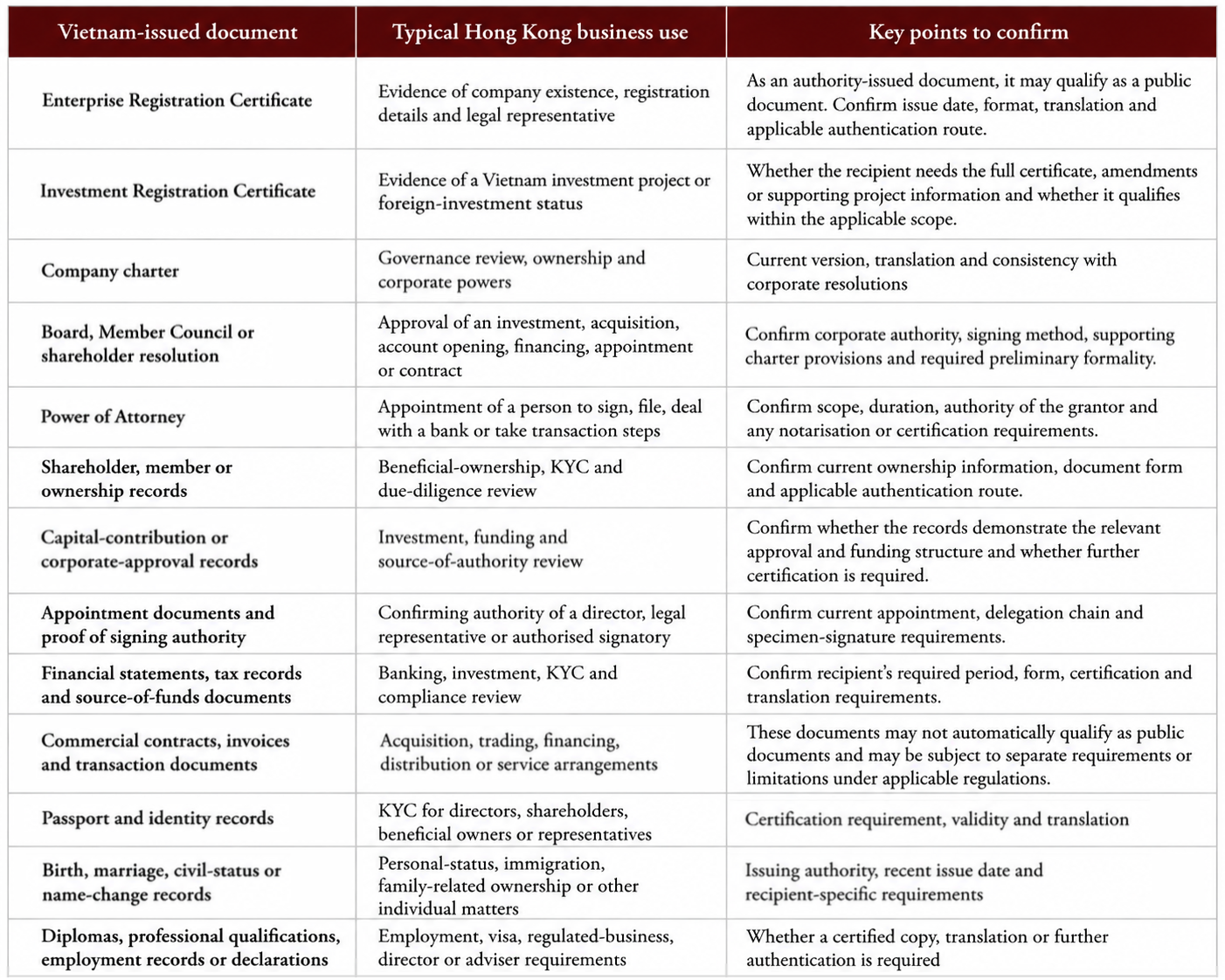
Table 1: Overview of Vietnam-Issued Documents, Typical Hong Kong Business Applications, and Verification Requirements
The same document may be treated differently by different recipients. A Hong Kong bank may accept a certified copy with supporting KYC information, while an authority or counterparty may require a differently authenticated document or a specific translation.
PCA Note
A Vietnamese company’s registration documents, corporate approvals, ownership information, Powers of Attorney, commercial documents and personal supporting records can all affect the timing of an investment, company incorporation, acquisition, banking or other cross-border step.
PCA can assist businesses in reviewing the relevant Vietnam-issued document set and coordinating the applicable Vietnam-side preparation and formalities with relevant authorities, based on the requirements confirmed for each case. The final decision to accept a document remains with the relevant Hong Kong bank, authority, counterparty, adviser or other receiving party.
For further consultation on Vietnamese companies, commercial or personal documents for investment, company expansion, banking or other business use in Hong Kong, businesses may contact PCA for tailored advisory support based on their specific situation.
Email: info@pca-cs.com
Hotline: +84 (0) 90909 0415 | +84 (0) 909091141
Author: The Legal & Compliance Department
Tags: #HongKongDocuments, #HongKongNotarisation, #HongKongApostille, #ConsularLegalisation, #CrossBorderBusiness, #CorporateDocuments, #PCACompanyServices