
Can Vietnamese Individuals Invest in Hong Kong or Singapore? A Practical Guide to Vietnam’s 2026 Outbound Investment Rules
Introduction
For Vietnamese individuals planning to establish or invest in a company in Hong Kong or Singapore, overseas incorporation is only the first step. The more important consideration is how investment capital can be transferred lawfully from Vietnam—and how dividends or other investment returns can later be brought back.
Vietnamese individuals may, in principle, make such investments, provided that they meet the applicable outbound-investment, banking and foreign-exchange requirements. In practice, the overseas investment structure, Vietnam filing, bank account and payment records must be aligned before any capital is transferred.
This article explains the practical route for direct investment in a Hong Kong or Singapore business, including the key requirements for contributing capital from Vietnam and returning dividends lawfully.
Article Outline
- I. Can a Vietnamese Individual Invest Abroad?
- II. Is This a Direct Business Investment?
- III. Which Vietnam Filing Route Applies?
- IV. How Should the Investment Be Implemented?
- V. What Should Investors Consider in Hong Kong or Singapore?
- VI. How Should Capital and Dividends Move?
- PCA Note
I. Can a Vietnamese Individual Invest Abroad?
Generally, yes. Vietnamese individuals may invest abroad by establishing an overseas company, contributing capital to an existing company, acquiring an ownership interest with a genuine management role, or investing under an overseas business contract.
For a Hong Kong or Singapore company, the investor should be able to demonstrate a genuine commercial project, including:
- The company’s intended business activity;
- The investor’s ownership and management role;
- The investment amount and contribution schedule;
- A lawful and documentable source of funds; and
- A clear operating purpose and timeline.
This is not a route for sending personal funds to an overseas company or bank account without a documented investment project.
Before proceeding, the investor should confirm personal eligibility, the legality of the intended activity, the source of funds and whether the planned banking route can support both the capital contribution and future return of profits.
II. Is This a Direct Business Investment?
The key question is whether the investor will own and actively participate in a real overseas business.
An eligible Vietnamese individual establishing or managing a Hong Kong or Singapore operating company may use the outbound-investment route, subject to the required procedures. Passive investments, such as foreign listed shares, funds or securities, and overseas property purchases do not automatically follow the same route.
This distinction should be confirmed before the company is incorporated or any payment is made.
III. Which Vietnam Filing Route Applies?
For most projects, the route depends on two questions:
- Is the total investment below VND 7 billion?
- Is the proposed activity in a conditional sector?
Before considering either question, the investor should ensure that the proposed activity is not prohibited for overseas investment.
- Activities That Cannot Be Used for an Overseas Investment Project
Under the Law on Investment No. 143/2025/QH15, prohibited activities include trading in narcotic substances; certain prohibited chemicals and minerals; endangered wildlife specimens; prostitution-related businesses; trading in human beings, human tissues, body parts or embryos; human cloning; firecracker trading; debt collection services; trading in national treasures; export of relics and antiques; and trading in electronic cigarettes or heated tobacco products.
Only after confirming that the proposed activity is not prohibited should the investor determine whether it falls within a conditional overseas investment business line requiring additional approvals.
|
Project profile |
Vietnam investment step |
What this means in practice |
|
Below VND 7 billion and not in a conditional sector |
No Outbound Investment Registration Certificate is required. The investor declares the project on the National Investment Information System and receives an automatically generated filing code. |
The investor must still complete the required banking and foreign-exchange procedures before sending capital. |
|
VND 7 billion or more, or in a conditional sector |
Apply for an Outbound Investment Registration Certificate. |
The certificate, foreign-exchange registration and outbound investment capital account must be opened before the capital transfer. |
|
VND 1,600 billion or more, or involving special support policies |
Additional review involving the Prime Minister applies. |
The project requires specific planning and review. |
Conditional sectors include banking, insurance, securities, press, radio, television and real-estate business.
The key point is simple: no certificate required does not mean no procedure required. Smaller non-conditional projects still need a genuine project, a Vietnam filing code, tax documentation, an outbound investment capital account and foreign-exchange registration.
IV. How Should the Investment Be Implemented?
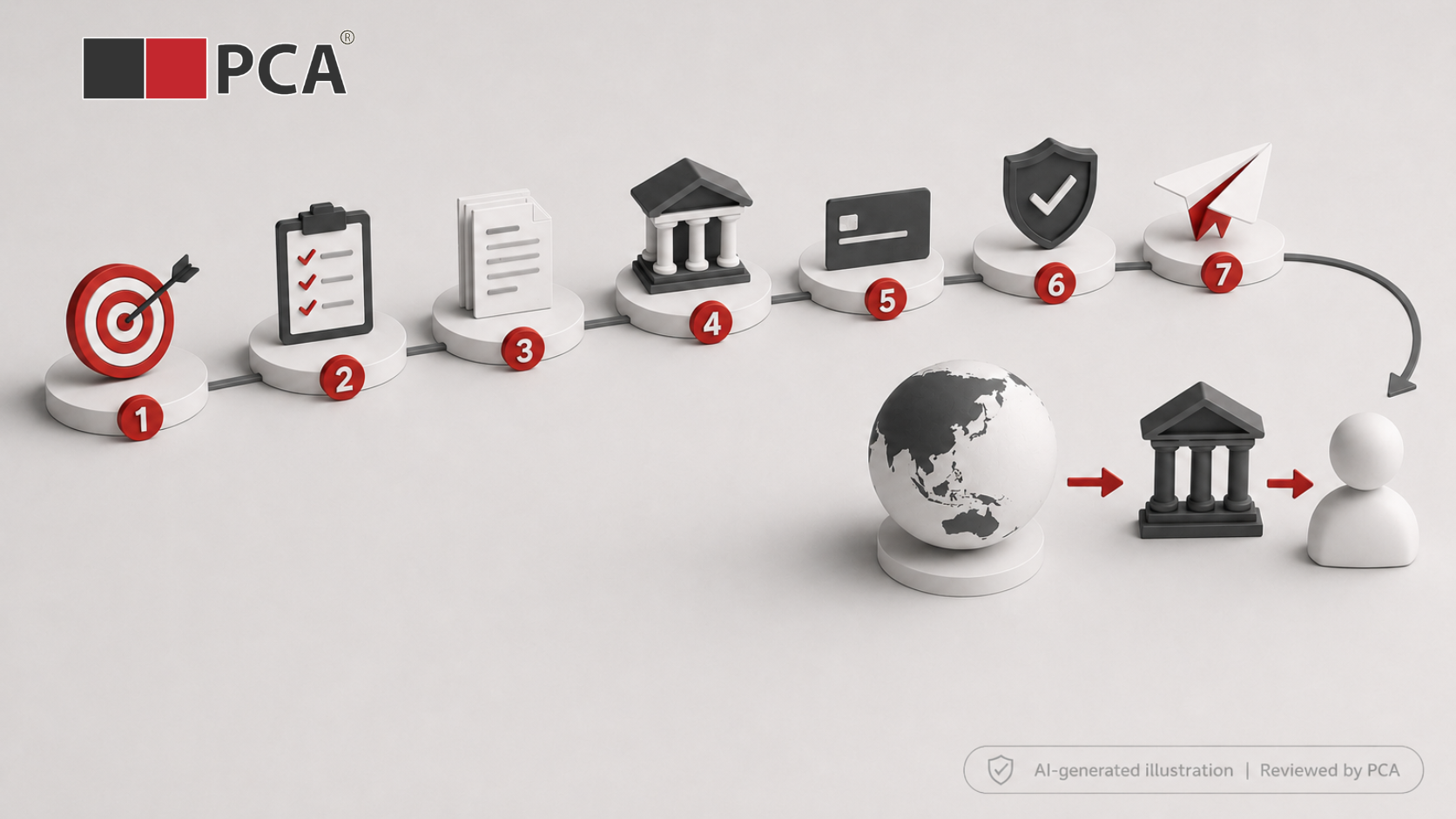
For a typical investment into a Hong Kong or Singapore operating company, the safest order is:
1. Structure the project.
Confirm the business activity, jurisdiction, ownership, management role, capital amount, contribution schedule, project term and source of funds.
2. Confirm the Vietnam route.
Determine whether the project qualifies for the below-VND-7-billion filing route or requires an Outbound Investment Registration Certificate.
3. Prepare supporting documents.
The documents should support one consistent investment story. Depending on the structure, they may include tax records, overseas company documents, shareholder records, subscription or share-purchase documents, investment agreements and documents evidencing the investor’s ownership and decision-making rights.
4. Complete the Vietnam filing.
Obtain the required certificate or, for an eligible smaller project, complete the declaration and obtain the filing code.
5. Open the correct Vietnam bank account.
The investor must use an outbound investment capital account with a permitted bank in Vietnam. This is different from a Direct Investment Capital Account (“DICA”), which is used for foreign investment coming into Vietnam.
6. Complete foreign-exchange registration.
The investor should obtain the required confirmation from the competent State Bank authority before transferring investment capital.
7. Transfer capital through the registered account.
The payment amount, beneficiary, purpose and timing should match the Vietnam filing, foreign-exchange registration and overseas corporate records.
V. What Should Investors Consider in Hong Kong or Singapore?
Both Hong Kong and Singapore generally permit foreign investors to hold 100% ownership of a company, subject to the applicable local laws and the nature of the proposed business activity.
Singapore has a specific local-presence requirement: the company must appoint at least one ordinarily resident director. Hong Kong companies remain subject to their own local incorporation and ongoing compliance requirements.
These overseas requirements do not replace the investor’s obligations in Vietnam. Before transferring capital, the investor must still complete the applicable Vietnam investment filing, use the registered outbound investment capital account and complete the required foreign-exchange process.
VI. How Should Capital and Dividends Move?
The outbound investment capital account is the controlled bank channel for the project. It is not the investor’s ordinary personal payment account. It is also not a Direct Investment Capital Account (DICA), which is used for foreign investment coming into Vietnam.
The expected money flow is: Lawful funds in Vietnam → outbound investment capital account → overseas company as investment capital → dividend or other lawful investment return → the same outbound investment capital account → the investor’s personal payment account in Vietnam
Before a dividend is paid, the overseas company should have distributable profits and complete the relevant financial statements, tax filings and corporate approvals. The payment records should clearly identify the amount as a dividend or other lawful investment return.
Profits and other investment income generally must be brought back to Vietnam within 12 months from the date of distribution. If the investor intends to retain profits abroad for reinvestment, the relevant Vietnam filing or adjustment should be considered before doing so.
PCA Note
The main risk is usually not overseas incorporation itself. It is following the wrong sequence — for example, incorporating the company and transferring capital before the Vietnam investment and banking route has been confirmed.
Before committing funds, the investor should ensure that:
- The overseas company is a genuine structure matching the intended business;
- The investor’s ownership and management role are clearly documented;
- The correct Vietnam filing route is confirmed;
- The outbound investment capital account and foreign-exchange registration are in place before capital is sent; and
- The overseas corporate records, Vietnam filings and bank payments all tell the same investment story.
Hong Kong and Singapore can both support regional expansion. The appropriate jurisdiction should be selected based on where the business will operate, who will manage it, local-presence requirements, banking feasibility, expected customers and the intended use of future profits.
For individual investors seeking tailored guidance on the structuring and implementation of an outward investment, the PCA Team remains available to review the proposed arrangement and discuss the relevant regulatory, banking and foreign-exchange considerations based on the circumstances of each case.
Email: info@pca-cs.com
Hotline: +84 (0) 90909 0415 | +84 (0) 909091141
Author: Chief Legal Officer – Attorney-at-law, Ms. Trương. M. Đ. Thư
— References and Detailed Notes —
The following notes provide further detail for readers assessing a specific structure. They should be read together with the main article and the requirements of the relevant authorities and banks.
1. Eligible Investors and Restricted Cases
Decree No. 103/2026/ND-CP excludes persons covered by Clause 2, Article 17 of the Law on Enterprises. This may be relevant to certain public officials, civil servants, public employees and other restricted persons.
For an overseas project involving press, radio or television activities, the ordinary individual-investor route is not available. The investor must be a Vietnamese organisation licensed in the relevant field and obtain written approval from the competent authority.
2. Recognised Forms of Outbound Investment
|
Investment form |
Plain-language meaning |
Typical use |
|
Establishing an overseas economic organisation |
Setting up a company or other recognised business entity overseas |
Establishing and operating a Hong Kong or Singapore company |
|
Investing under an overseas contract |
Investing through a contractual arrangement without necessarily establishing a new company |
A joint project, cooperation arrangement or contract-based venture |
|
Contributing capital or acquiring shares or an ownership interest to participate in management |
Investing in an existing overseas company with a genuine ownership and management role |
Acquiring an interest in an operating business |
|
Buying foreign securities or investing through overseas funds or financial intermediaries |
Passive investment in shares, bonds, funds or similar products |
Portfolio investment under a separate indirect-investment framework |
|
Other forms permitted by the destination jurisdiction |
Other structures recognised under local law, subject to Vietnamese requirements |
Case-specific structures requiring review |
3. Additional Filing and Foreign-Exchange Details
For ordinary projects below VND 7 billion that do not fall within a conditional sector, the filing code is generated through the National Investment Information System.
For an ordinary non-certificate project handled by the relevant regional State Bank authority, the stated processing period for foreign-exchange registration is 30 working days after receipt of a complete and valid dossier. For an ordinary certificate project, the stated processing period is 7 working days after receipt of a complete and valid dossier.
For a project requiring an Outbound Investment Registration Certificate, the general stated processing period is 15 working days after receipt of a complete and valid dossier.
4. Pre-Investment Transfers
A project-specific pre-investment account may be used for legitimate formation costs before the main investment process is completed.
These transfers are limited to 5% of the total investment capital and USD 300,000. They form part of the project’s total investment capital and should not be used as an early route for paying subscribed capital.
5. Return and Reinvestment of Profits
If profits and other investment income cannot be returned to Vietnam within the usual 12-month period, the investor must notify the Ministry of Finance and the State Bank of Vietnam in writing before the deadline. Any extension is limited to a further 12 months.
Profits may remain abroad only for permitted purposes, including completing the committed capital of the existing project, increasing its capital or implementing a new outbound investment project. A new filing or adjustment may be required before reinvestment.
6. Legal References
- Law on Investment No. 143/2025/QH15;
- Decree No. 103/2026/ND-CP on outbound investment; and
- Circular No. 34/2026/TT-NHNN on foreign-exchange management for outbound investment, effective from 31 July 2026.
Tags: #VietnamOutboundInvestment #VietnamCompliance #InvestAbroadVietnam #HongKongBusiness #SingaporeCompany #DirectInvestment #ForeignExchangeVietnam #LegalAdvisory #InvestmentLaw2026 #DividendRepatriation #CrossBorderInvestment #BusinessAdvisory