
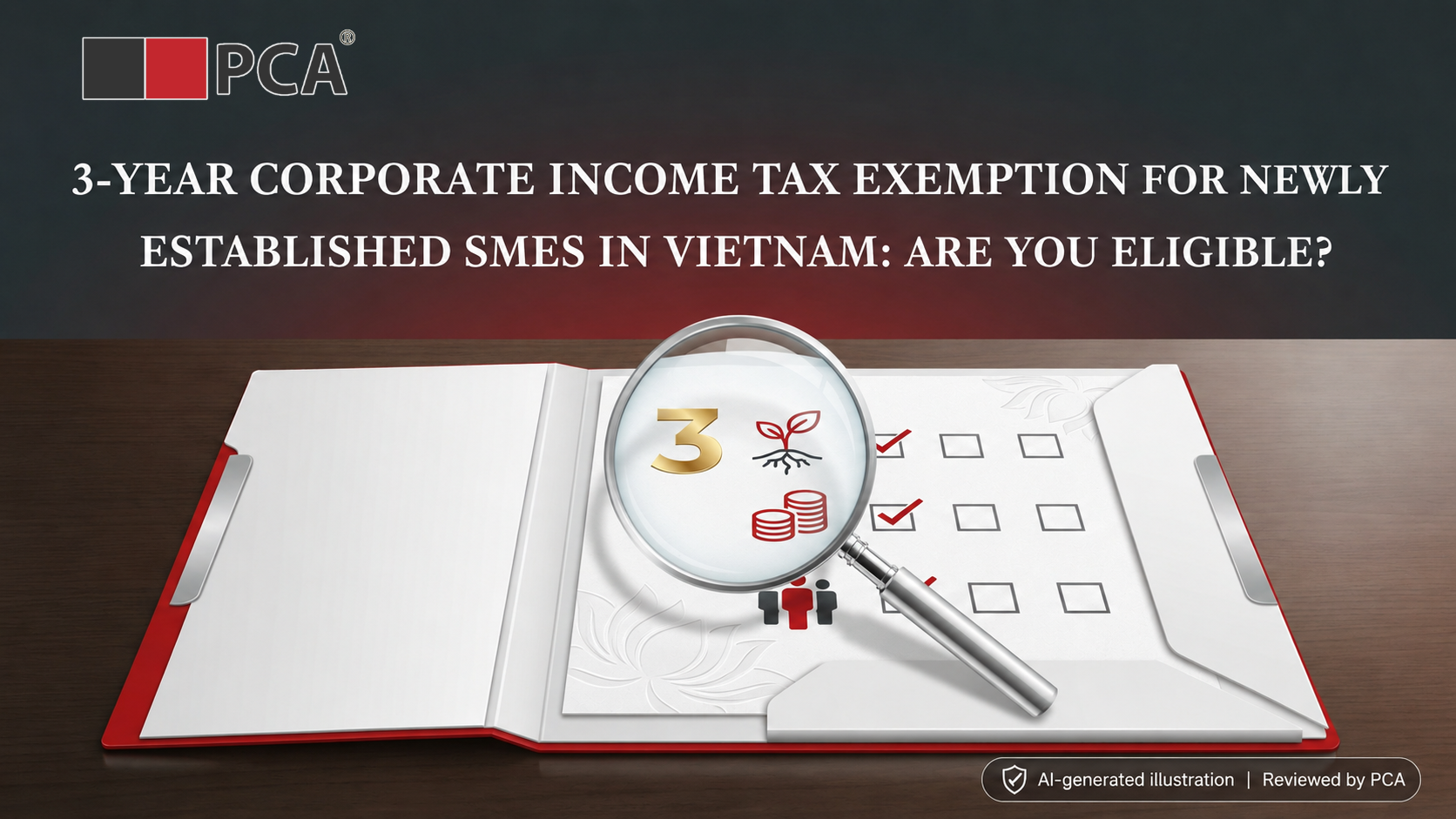
3-Year Corporate Income Tax Exemption for Newly Established SMEs in Vietnam: Are You Eligible?
Introduction
In a wider effort to support the private economy, the National Assembly issued Resolution No. 198/2025/QH15, and the Government later issued Decree No. 20/2026/NĐ-CP to implement key parts of that Resolution, including the 3-year corporate income tax (CIT) exemption for eligible small and medium-sized enterprises (SMEs). The headline sounds straightforward, but the practical question is more important: not every newly established company is automatically entitled to the incentive.
From a business perspective, this policy can be especially valuable during the first stage of operation, when cash flow is usually directed toward hiring, product development, market entry, and growth. The challenge is knowing whether your company truly fits the legal test for the exemption, and whether any exclusion rules may apply.
Article Outline
- I. Who May Benefit From the 3-Year CIT Exemption?
- II. How to Know Whether Your Business Is an SME
- III. Which Cases Are Excluded?
- IV. When Does the Incentive Apply?
- V. A Broader Signal: Vietnam’s Continued Support for Business Growth
- PCA Note
I. Who May Benefit From the 3-Year CIT Exemption?
Under Decree No. 20/2026/NĐ-CP, the 3-year CIT exemption applies to SMEs that register business for the first time. The exemption is available for three consecutive years, calculated continuously from the first year in which the enterprise was granted its first Enterprise Registration Certificate. If the certificate was issued before the effective date of Resolution No. 198/2025/QH15 and the enterprise still has remaining entitlement, it may continue to enjoy the remaining exemption period.
Importantly, foreign-invested enterprises are not automatically excluded. The Ministry of Finance has explained that FDI companies established under Vietnamese law may still benefit if they meet the SME criteria and satisfy the relevant conditions.
For businesses, the key point is simple: being newly established is not enough on its own. The company must also fall within the SME framework and avoid the exclusion cases under the decree.
Key Takeaway: The incentive is for newly registered SMEs, not for every new company. Eligibility depends on both SME status and the anti-abuse rules in the decree.
II. How to Know Whether Your Business Is an SME
SME status is determined under the SME support framework, and the classification is based mainly on the enterprise’s main registered business line, the average number of employees participating in social insurance, and either annual revenue or total capital.
SME criteria under Decree 80/2021/NĐ-CP
|
Type of enterprise |
Sector |
Average annual employees with social insurance |
Maximum annual revenue |
Or maximum annual capital |
|
Small enterprise |
– Agriculture, forestry, fisheries; industry and construction – Trade and services |
– Up to 100 – Up to 50 |
– Up to VND 50 billion – Up to VND 100 billion |
– Up to VND 20 billion – Up to VND 50 billion |
|
Medium enterprise |
– Agriculture, forestry, fisheries; industry and construction – Trade and services |
– Up to 200 – Up to 100 |
– Up to VND 200 billion – Up to VND 300 billion |
– Up to VND 100 billion – Up to VND 100 billion |
These thresholds come from Article 5 of Decree No. 80/2021/NĐ-CP. The decree also explains that the enterprise’s sector is determined by its main registered business line, and that the employee count is calculated using the average number of employees participating in social insurance over the year.
A practical point many businesses miss is that SME status is not just a label. It is a legal classification that should be checked carefully against the company’s actual staffing, revenue, and capital data.
Key Takeaway: To assess eligibility, a business must first confirm that it falls within the SME thresholds under Decree 80/2021/NĐ-CP.
III. Which Cases Are Excluded?
The exemption is designed to support genuine first-time business establishment, not restructuring in a new form. For that reason, the decree excludes several cases, including:
- enterprises formed through merger, consolidation, division, separation, ownership transfer, or conversion of enterprise type; and
- newly formed companies where the legal representative (except where that person is not a contributing member), the general partner, or the largest capital contributor has already been involved in an active business, or in a business that was dissolved within the prescribed 12-month period before the new company was established.
- The exemption also does not apply to certain categories of income specified under Clause 3, Article 18 of the 2025 Corporate Income Tax Law, which remain subject to separate tax treatment under the applicable regulations.
In other words, the authorities are looking not only at the new company itself, but also at the background of its founders and the broader business history behind the structure.
Key Takeaway: A company with restructuring history or a founder tied to a recent or existing business should review the anti-abuse rules carefully before assuming the exemption applies.
IV. When Does the Incentive Apply?
The exemption starts from the first year of the first Enterprise Registration Certificate and runs for three consecutive years. If the first tax period is shorter than 12 months, the business may choose to apply the exemption from that first period or from the next tax period.
This timing point matters because some companies established before the policy took effect may still have part of the 3-year period left. The Ministry of Finance has confirmed that where an enterprise was registered before the relevant policy took effect but still has remaining entitlement, it may continue to benefit for the remaining period.
For that reason, businesses that already filed their 2025 CIT finalization should review whether the exemption was properly reflected. If not, they should check their tax position promptly and, where needed, discuss the appropriate filing steps with their tax advisor. This is especially important because the enterprise is responsible for self-determining whether the conditions are met when applying the incentive.
Key Takeaway: Eligible enterprises may still benefit from the exemption within the remaining period, and timing should be reviewed carefully to avoid missing available tax savings.
V. A Broader Signal: Vietnam’s Continued Support for Business Growth
Viewed more broadly, the 3-year CIT exemption is not simply a tax incentive.
It reflects a wider policy direction aimed at encouraging entrepreneurship, supporting the private sector, and reducing the financial burden on businesses during their early years of operation.
In recent years, Vietnam has introduced a range of measures intended to strengthen the business environment, simplify administrative procedures, and create more favourable conditions for investment and business expansion. The introduction of the SME tax exemption under Resolution No. 198/2025/QH15 and Decree No. 20/2026/NĐ-CP forms part of this broader effort.
For startups and newly established enterprises, the first few years are often the most challenging. Resources are typically allocated toward recruitment, product development, market entry, technology investment, and customer acquisition. Reducing the corporate income tax burden during this period may provide additional flexibility for businesses to reinvest capital into growth.
From a policy perspective, the measure also signals Vietnam’s continued commitment to supporting private enterprise as an important driver of economic development.
At the same time, the incentive framework demonstrates that support measures are increasingly accompanied by clear eligibility rules and anti-abuse safeguards. The objective is not only to encourage new business formation, but also to ensure that the benefits are directed toward genuinely new entrepreneurial activities.
Key Takeaway: The 3-year CIT exemption is more than a tax incentive. It reflects Vietnam’s broader effort to foster entrepreneurship, strengthen the private sector, and create a more supportive environment for business growth and investment.
PCA Note
The introduction of the 3-year Corporate Income Tax exemption reflects Vietnam’s broader efforts to support entrepreneurship, reduce the initial tax burden on small and medium-sized enterprises, and encourage private sector growth.
However, as with many tax incentives, the practical challenge often lies not in understanding the headline policy itself, but in assessing how the detailed eligibility conditions apply to a particular business structure, ownership background, and operational situation. While the incentive may appear straightforward at first glance, eligibility depends on several factors, including SME classification, the circumstances surrounding the establishment of the enterprise, the background of key founders or contributors, and the application of specific exclusion provisions under the relevant regulations.
As implementation continues to develop, businesses may wish to review their circumstances carefully to determine whether the applicable conditions have been satisfied and whether the incentive is available in their particular case. This may be particularly relevant for enterprises established before the policy took effect, businesses with restructuring histories, or companies whose founders have previously been involved in other enterprises.
For businesses seeking further clarification on the application of the new rules, the PCA Team remains available to assist in reviewing specific circumstances and discussing potential compliance considerations based on the facts of each case.
Email: info@pca-cs.com
Hotline: +84 (0) 90909 0415 | +84 (0) 909091141
Author: Chief Financial Officer, Mr. Nguyen Quoc Tu
Tags: #VietnamTax, #CorporateIncomeTax, #CITExemption, #SMEVietnam, #TaxIncentivesVietnam, #VietnamBusiness, #VietnamCompliance #VietnamSME
#BusinessInVietnam #VietnamInvestment #CorporateTaxVietnam #VietnamTaxIncentives #StartupsVietnam